From Kata to Poomsae: The Okinawan Roots of Korean Martial Arts Forms
The forms practiced in Korean dojangs originally come from Okinawa. Some of this history is well documented, while other parts rely on organizational stories or even folklore.
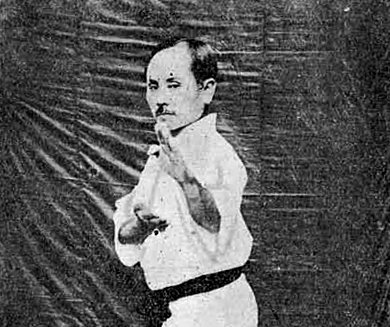
When a student learns Taegeuk Il Jang today, they are practicing a Korean form created in the early 1970s. The stances, blocks, and floor patterns are based on foundations established in Okinawa many years earlier by teachers who never visited a Korean dojang.
Korean taekwondo literature itself acknowledges this lineage: two Korean texts from 2000 and 2001, one co-written at the Kukkiwon, concede karate's influence, as quoted in Shin Dong-A (April 2002, p. 306). Before the Korea Taekwondo Association issued its own forms in 1967, Korean schools largely practiced karate-style forms, according to the Korean history of the period by Kang Won-sik and Lee Kyong-myung, as summarized in Korea Martial Arts News. Lee Chong-woo, who supervised the KTA's forms committee, stated this on the record in 2002 (see "The kwan era" below).
The details are less certain. Some connections between Okinawan kata and Korean forms are documented in the writings of their creators. Others depend on how federations and schools recount their histories, and some are simply folklore. This article examines each family of forms and separates these three types of evidence.
One sequence, three names
A lot of the confusion about these forms stems from their names. The same sequence can have Okinawan, Japanese, and Korean names, often using the same Chinese characters.
The Japanese layer largely stems from Gichin Funakoshi. When he brought Okinawan karate to mainland Japan, he replaced many Okinawan and Chinese-derived kata names with Japanese ones. His Karate-dō Kyōhan (1935) is where Kushanku became Kankū, "viewing the sky" (Wikipedia, citing Funakoshi 1935). Other names settled in later editions: the 1936 printing still referred to Naihanchi alongside a new name, and "Tekki" appears alone only in the 1956 edition (Naihanchi).
The Korean layer is simpler. The early kwans pronounced the same characters the same way in Korean, so 平安 (Pinan/Heian) became Pyung Ahn. The words for "form" follow the same pattern: kata in Japanese, hyung in older Korean usage and in Tang Soo Do, tul ("pattern") in ITF taekwondo, and poomsae in Kukkiwon taekwondo.
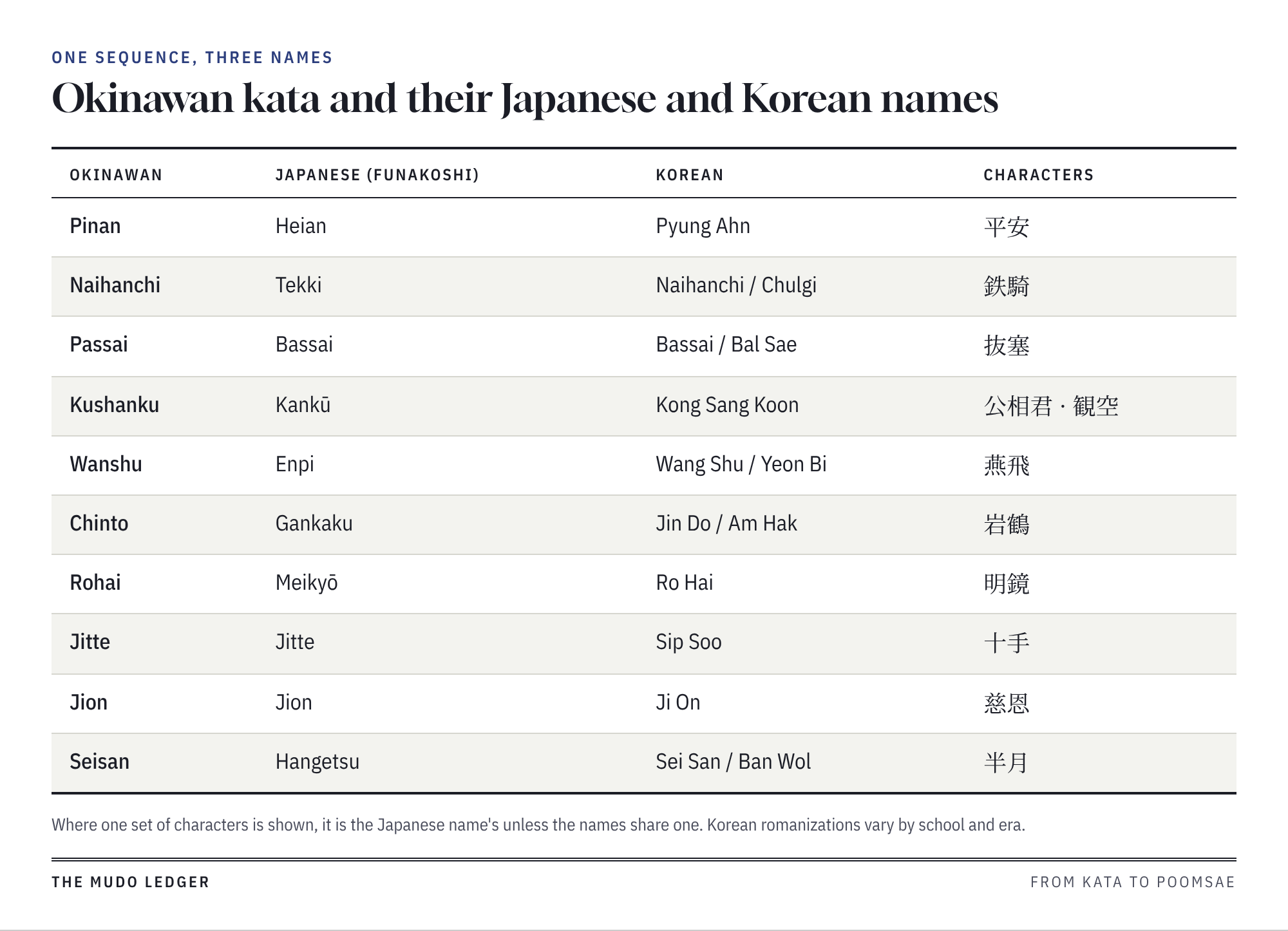
Korean romanizations vary by school and era. Matching characters is a more reliable way to connect names than matching spellings.
The Okinawan sources
Pinan. The five Pinan kata are the clearest example. Itosu Ankō created them as teaching forms when karate entered Okinawa's school system, which he began in 1901 at Shuri's primary school. His student Motobu Chōki wrote in 1926 that Itosu created them as teaching material (Fighting Arts). Their exact date is uncertain: published accounts cite years from 1895 to 1907, and one Okinawan study places their official introduction in the spring of 1904. They are commonly said to draw on Kushanku and a lost form called Channan (Pinan). Funakoshi renamed them Heian and swapped the order of the first two.
Kushanku. This kata is named after a person documented in a historical text. The Ōshima Hikki, notes compiled in 1762 by the scholar Tobe Yoshihiro, records an Okinawan account of a Chinese man named Kōshōkun demonstrating a grappling art (Jissen Karate). He is usually linked to the 1756 Chinese investiture mission to Ryūkyū. That the kata descends from him is a matter of lineage tradition; researchers have found no official Chinese record of him (Karate by Jesse).
Wanshu. Wanshu follows the same pattern. Wang Ji, who led a Qing mission to Ryūkyū in 1683, is a documented historical figure. The kata either came from him or was composed by his students; neither version is documented (Wanshū). Funakoshi renamed it Enpi, "flying swallow."
Naihanchi, Passai, and the Tomari kata. Naihanchi, performed sideways in a straddle stance, was the first kata in the Shuri and Tomari schools before the Pinan kata existed. Some researchers credit Itosu with the second and third parts; others think one form was split into three (Naihanchi). Passai ("to storm a fortress") belongs to the Shuri line. Rohai, Jitte, Jion, Chinto, and Wanshu are associated with Tomari village. Their creators are unknown. The story that Chinto was a shipwrecked Chinese sailor who taught Matsumura Sōkon is folklore with no documentary source.
Taikyoku. The simplest of these forms came last. Shotokan's Taikyoku kata were developed in Japan as a basic introduction to kata; Shotokan sources credit Funakoshi's son, Yoshitaka, with Taikyoku Shodan (Shotokan). Their name, 太極, uses the same characters as the Korean Taegeuk.
The kwan era: karate under Korean names
The men who founded Korea's postwar kwans had mostly trained in Japan or under Japanese-trained teachers. They taught what they had learned. Pinan became Pyung Ahn, Naihanchi became Chulgi, Kushanku became Kong Sang Koon, and Jitte became Sip Soo. A 1950s textbook by Ch'oe Song-nam, a Chung Do Kwan member who taught in the military, shows only Shotokan kata plus one form of his own, according to a 2023 study in The International Journal of the History of Sport (Taylor & Francis).
Firsthand testimony comes from Lee Chong-woo of Jidokwan, who supervised the KTA forms committee and later served as a Kukkiwon vice president. In an April 2002 interview with the Korean monthly Shin Dong-A, he said the early training he received was karate under a Korean name. He then described the creation of the official forms: "All the masters who taught Karate got together and formulated basic Taekwondo forms." He said he took a central role (English translation, Shin Dong-A, p. 307).
Two cautions apply to that source. The interview is best known for Lee's statements about Olympic judging, and the English translation is widely circulated among critics of the Kukkiwon. His account of the forms is consistent with the Korean histories cited here, but it is one participant's recollection, 35 years after the fact.
Hwang Kee's alternative
Hwang Kee's Moo Duk Kwan preserved the inherited kata, now taught in Tang Soo Do and Soo Bahk Do as Pyung Ahn, Bassai, Naihanchi, and the rest. It also added forms of its own, more than a decade before the KTA produced any.
The beginner Kicho hyung are credited by Moo Duk Kwan sources to Hwang Kee around 1947 (Taekwondo Wiki). Structurally, they resemble Shotokan's Taikyoku, though no Moo Duk Kwan source we found states that one was adapted from the other. A fourth, Kicho Sa Bu, was added later by Grandmaster Sun-hwan Chung (Sun-hwan Chung).
According to Soo Bahk Do sources, the Chil Sung ("seven stars") hyung are dated to 1952, and the Yuk Ro ("six paths") hyung to about 1957–58. Hwang Kee said he drew on the Muye Dobo Tongji, the illustrated military manual compiled under King Jeongjo in 1790, which a librarian showed him in 1957 (Moo Duk Kwan). These dates pose a problem that his own lineage has noted: forms dated to 1952 cannot draw on a text he first saw in 1957. One Soo Bahk Do instructor concludes that whatever in Chil Sung reflects the manual must have been added after 1957 (Wasatch Martial Arts).
Hwang Kee also described training in Chinese martial arts in Manchuria. Korean taekwondo writers note that no source corroborates this training (Korean history summary).
Choi Hong-hi's alternative
General Choi Hong-hi learned karate in Japan; he trained in Kyoto under a Korean instructor named Kim and later said he also studied under Funakoshi (Choi Hong-hi). With army instructors, he developed his own set of forms, the Chang-hon tul, named after his pen name. He founded the International Taekwon-Do Federation in 1966.
The ITF syllabus includes 24 patterns, a number Choi associated with the 24 hours of the day. The authoritative reference is his 15-volume Encyclopedia of Taekwon-Do, last revised under his direct involvement in 1999, with volumes 8 to 15 devoted to the patterns (International Taekwon-Do Federation). Each pattern honors a figure or event in Korean history.
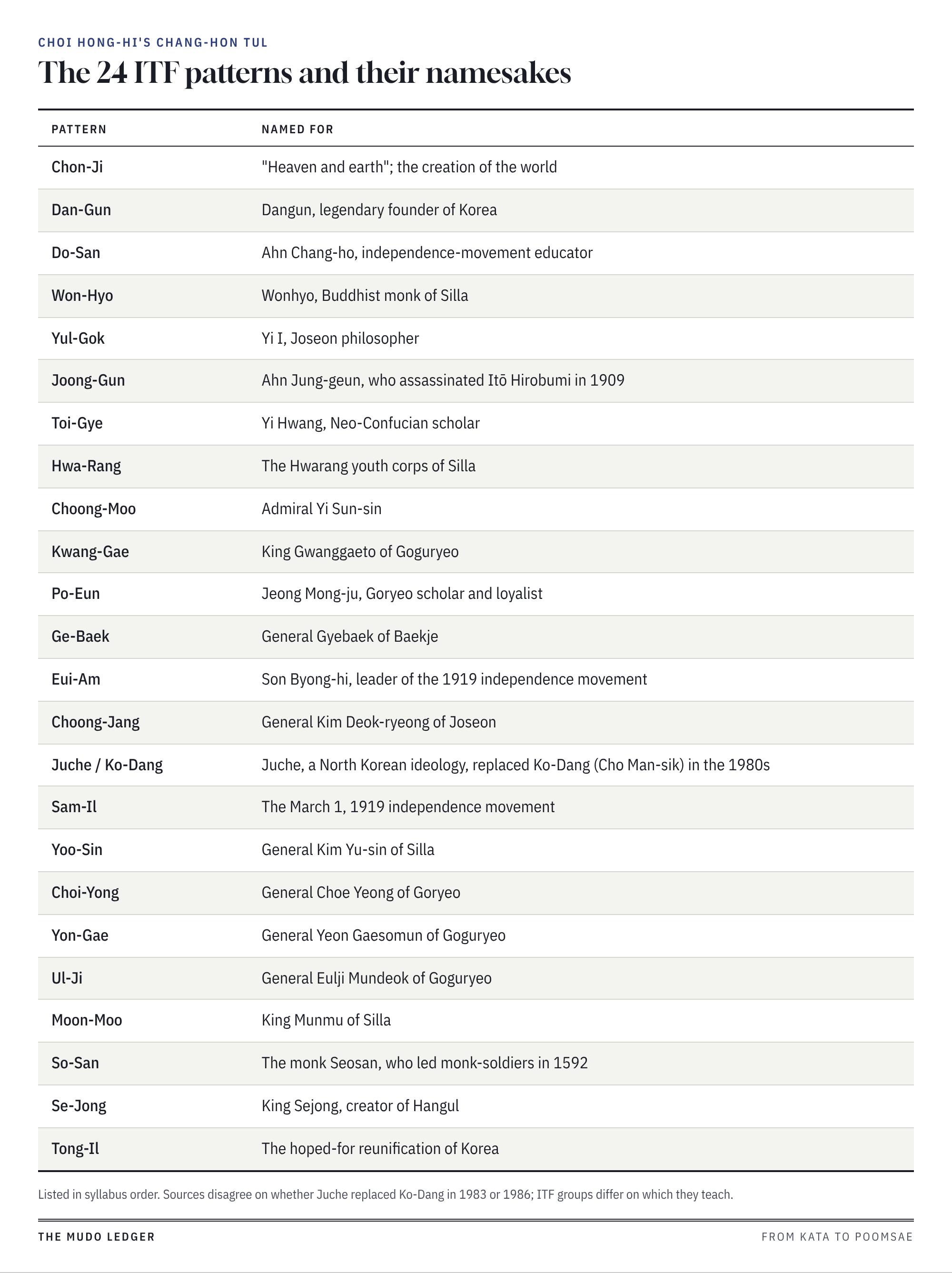
Sources disagree on whether Juche replaced Ko-Dang in 1983 or 1986, and ITF groups today differ on which of the two they teach (One Legacy ITF).
The KTA committee, 1965–1973
The Kukkiwon forms were developed by a committee. In 1965, the KTA formed a forms committee from members recommended by the kwans. Korean accounts list Kwak Kun-sik (a military academy instructor), Lee Young-sup (Song Moo Kwan), Lee Kyo-yoon (Han Moo Kwan), Park Hae-man (Chung Do Kwan), Hyun Jong-myun (Oh Do Kwan), and Kim Soon-bae (Chang Moo Kwan) as the creators of the first forms, with Lee Chong-woo supervising (Korea Martial Arts News, citing Lee Kyong-myung 2005 and Kim Woo-kyu et al. 2005).
The first set, issued in 1967–68, included 17 forms: eight Palgwe color-belt forms and nine black-belt forms, Koryo through Ilyeo (Taekwonmaru). Some names changed later. A study in the Kukkiwon's own research journal found that the forms now called Pyongwon and Ilyeo were originally named Baekje-hyung and Silla-hyung, and that the Palgwe forms were reordered (KCI). Around 1971, the original Koryo was replaced by a new form of the same name (Hyeong).
The Taegeuk forms followed. Korean sources date them to a 1972 technical committee (Taekwonmaru), and South Korea's education ministry adopted them into the school physical-education curriculum in 1973 (Namuwiki). Some English sources place the switch from Palgwe at 1971. Bae Young-ki of Jidokwan and Han Young-tae of Moo Duk Kwan joined the committee for this work (Korea Martial Arts News; Taegeuk Il Jang). Although Hwang Kee stayed out of unification, a Moo Duk Kwan representative helped build the Taegeuk series.
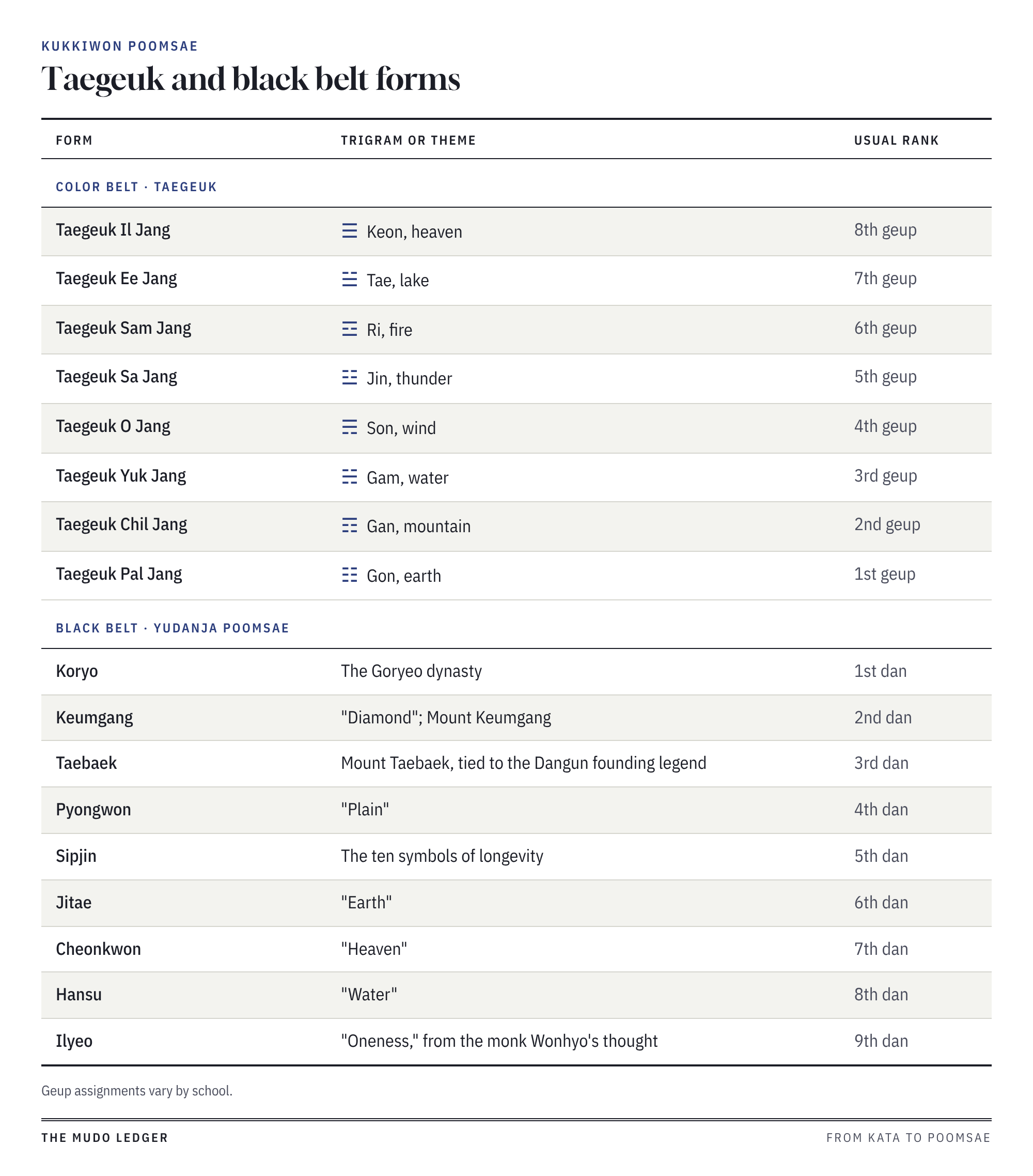
The Kukkiwon's textbook associates each Taegeuk form with one of the eight trigrams and each black belt form with a named idea.
What carried over
The committee's stated aim was original Korean forms, and the Kukkiwon forms are not karate kata with new names. But the inheritance is evident, and some of it is on record. Lee Chong-woo said the basic blocks and strikes of the early schools were identical to karate's (Shin Dong-A, p. 307). Korean writers note that poomsae, like kata, open with a block and end where they began (Namuwiki).
Other similarities listed here are based on this publication’s own comparisons of the forms, not on statements from the original designers:
- The Taegeuk floor pattern, three parallel lines joined by a center line, resembles the I- or H-shaped path of the Pinan and Taikyoku kata.
- Taegeuk and Taikyoku share the character 太極. No committee source we found indicates the name was borrowed; both draw on the same classical term.
- Braced, slow-tension movements in Keumgang and Taebaek resemble those in Jitte, Jion, and Bassai, and wide straddle-stance sections recall Naihanchi.
There are also clear differences: the stances became higher and shorter, there is more emphasis on kicking, and the names and symbolism now come from Korean history and the I Ching instead of Okinawan teachers.
Methodology and Sourcing
The Mudo Ledger rates every substantive claim based on how solid its evidentiary footing is, rather than on how confidently or how often it is repeated.

Tier 1
- The names, order, trigram assignments, and stated meanings of the eight Taegeuk forms and nine black belt poomsae, as codified by the Kukkiwon
- The 24 Chang-hon patterns, their namesakes and the 24-hour symbolism, as set out in Choi Hong-hi's Encyclopedia of Taekwon-Do
- Funakoshi's Japanese renamings of Okinawan kata, published in Karate-dō Kyōhan (1935) and its later editions
- Hwang Kee's authorship of the Chil Sung and Yuk Ro hyung and his statement that he drew on the Muye Dobo Tongji, as his own account
- The Ōshima Hikki (1762) as a record of a Chinese martial artist called Kōshōkun on Okinawa, and Wang Ji's 1683 mission to Ryūkyū as a historical event.
- The Muye Dobo Tongji as a military manual compiled under King Jeongjo in 1790
Tier 2 — commonly taught, credited to originating organizations
- Itosu Ankō as creator of the Pinan kata, supported by his students' writing; their date (1895–1907 in different accounts) and their derivation from Kushanku and Channan remain lineage history, not record
- The naming of Kushanku and Wanshu after the two Chinese envoys — repeated across karate lineages, with no record linking either man to the kata
- The kwans' teaching of karate kata under Korean names — reported in Korean taekwondo histories (Kang Won-sik and Lee Kyong-myung, 1999) and a 2023 peer-reviewed study
- Lee Chong-woo's 2002 account that karate-trained masters formulated the basic forms — first-hand testimony in a published interview, available in English through critics of the Kukkiwon
- The 1965 committee's membership, the 1967–68 and 1972–73 dates, and the Baekje-hyung and Silla-hyung original names — Korean taekwondo histories and a Kukkiwon research-journal study, with some dates differing between Korean and English sources
- The dating of Kicho (about 1947), Chil Sung (1952), and Yuk Ro (about 1957–58), and Kicho Sa Bu's authorship by Sun-hwan Chung — Tang Soo Do and Soo Bahk Do sources
- Yoshitaka Funakoshi as author of Taikyoku Shodan — Shotokan sources
- The year Juche replaced Ko-Dang (1983 or 1986) — ITF sources disagree
Tier 3 — named explicitly as oral tradition/folklore, not fact
- Chinto as a shipwrecked Chinese sailor who taught Matsumura Sōkon
- Hwang Kee's training in Chinese martial arts in Manchuria — his own account, which Korean writers note is uncorroborated
- The resemblances listed under "What carried over" that are marked as this publication's observations: the floor-pattern likeness, the shared 太極 name, and the movement parallels in the black belt forms. These are comparisons, not documented design intent
If this article presents something as an established fact, it is Tier 1. If you see phrases like "commonly said," "credited," or "according to," that means the information comes from Tier 2 or Tier 3 sources, not settled history.
The sources for this history are uneven. Early Okinawan karate was mostly passed down through demonstrations and spoken teaching, so the first written records only appear around 1900. Stories about earlier times are mostly based on tradition. The Korean committee’s working papers, if they still exist, are not public, so the history depends on later accounts from participants and historians.
Sources
- Funakoshi, Gichin. Karate-dō Kyōhan (1935), as cited in Kūsankū (kata) and Naihanchi
- Roots of Shotokan, Part 2 — Fighting Arts
- Pinan · Wanshū · Shotokan
- Kusanku and the Ōshima Hikki incident — Jissen Karate
- "Kusankun" and the Oshima Incident — Karate by Jesse
- The So-Called 'First' Korean Taekwondo School — The International Journal of the History of Sport (2023)
- Interview with Lee Chong-woo — Shin Dong-A, April 2002 (English translation)
- '팔괘 사상'과 '태극7장' — Korea Martial Arts News
- 태권도 공인품새의 변화에 대한 고찰 — Kukkiwon Taekwondo Research (KCI)
- 팔괘 — Taekwonmaru · 태권도/띠의 체계와 품새 — Namuwiki
- Hyeong · Taegeuk · Taegeuk Il Jang
- Moo Duk Kwan · Sun-hwan Chung · Chil Sung Il Ro — Taekwondo Wiki
- Background of Chil Sung Hyung — Wasatch Martial Arts
- 태권도 역사 살펴보기 (Korean history summary)
- Choi Hong-hi · International Taekwon-Do Federation · The 24 ITF Patterns — One Legacy ITF