Haidong Gumdo vs. Kumdo: A Terminology-Verified Comparison
Kumdo's lineage to Kendo is undisputed. Haidong Gumdo's founders drew on real 18th-century Korean sword manuals—but its 'ancient Samurang warrior' origin story has no historical record behind it. A terminology-verified, source-tiered look at what's documented and what's marketing.
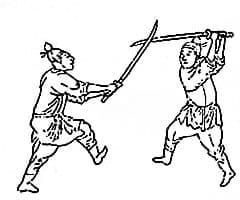
This piece treats claims about lineage as a ledger treats entries: nothing is recorded as fact without a source, and sources are weighted by their evidentiary strength. Three tiers are used throughout:
- Documentary record — legal rulings, contemporaneous publications, linguistic/etymological evidence.
- Organizational literature — federation histories, school websites, promotional materials. Useful for describing what a group teaches and believes, not for establishing historical fact on its own.
- Oral tradition / undocumented claim — stated as such, never presented as settled history.
Korean terms are given in Hangul (한글), Hanja (漢字) where applicable, and Revised Romanization (RR) — the official South Korean transliteration standard published by the Ministry of Culture, Sports and Tourism in 2000 — with common alternate spellings noted, because Kumdo/Haidong Gumdo literature in English is romanized inconsistently across schools.
Terminology reference
Term | Hangul | Hanja | RR | Common variants | Meaning |
Kumdo | 검도 | 劍道 | Geomdo | Kumdo, Gumdo, Kŏmdo | "Way of the sword" |
Haidong Gumdo | 해동검도 | 海東劍道 | Haedong Geomdo | Haidong Gumdo, Haedong Kumdo | "Eastern Sea sword way" |
Mudo | 무도 | 武道 | Mudo | — | "Martial way" |
Samurang | 사무랑 | 士武郞 | Samurang | — | Purported Goguryeo-era warrior order |
Muye Dobo Tongji | 무예도보통지 | 武藝圖譜通志 | Muyedobotongji | Muye Dobo Tongji, Muyejebo (earlier edition) | "Comprehensive Illustrated Manual of Martial Arts" (1790) |
Bonguk Geombeop | 본국검법 | 本國劍法 | Bonguk Geombeop | Bonkuk Gumbup | "National sword method" |
Mokgeom | 목검 | 木劍 | Mokgeom | Mokgum | Wooden practice sword |
Jingeom | 진검 | 眞劍 | Jingeom | Jingum | Live/sharpened blade |
Bogu | 보구 | 保具 | Bogu | — | Kendo/Kumdo armor set |
Two clarifications for editorial consistency in this publication: "Gumdo" and "Kumdo" are the same word (검도) under different romanization conventions — neither is more "correct" colloquially, though Geomdo is the RR-compliant form. Likewise, "Haidong" and "Haedong" render the same Hangul (해동); this piece uses Haidong Gumdo, the more common English search term and the spelling used by the largest federation, while noting Haedong Geomdo as the RR-correct form.
Kumdo: a documented lineage
Kumdo (검도/劍道) is the Korean-administered form of Kendo, the Japanese sword art. It was introduced to Korea during the Japanese colonial period (1910–1945) and continued afterward under Korean governance. Its lineage to Kendo is not disputed by any serious source — it is standardized by the Korea Kumdo Association and shares governing infrastructure with the International Kendo Federation.
Its practice is well documented and consistent across sources.
- Armor and equipment: full bogu (men, do, kote, tare) and a shinai (bamboo sword) for sparring.
- Curriculum: basic strikes, footwork, and prearranged kata — including the standardized "bon" forms shared with Kendo, though performed with modified etiquette and Korean terminology — progressing to full-contact point sparring.
- Historical forms component: Korean Kumdo also incorporates Bonguk Geombeop (본국검법/本國劍法) and Joseon Sebeop (조선세법/朝鮮勢法), sword methods documented in the Muye Dobo Tongji, thereby establishing a genuine link to indigenous Korean swordsmanship alongside its Kendo-derived sparring system.
- Governance: ranked through an internationally recognized dan/gup system.
Haidong Gumdo: verified history vs. organizational claim
This is where terminology precision matters most, because the name of the art itself has been the subject of formal dispute.
What is documented. The term Haidong Gumdo (해동검도/海東劍道) was coined around 1982. Litigation between the two largest rival federations — the Daehan Haidong Gumdo Federation (under Kim Jeong-ho, 김정호) and a rival Hanguk/Haedong federation (associated with Na Han-il, 나한일) — has produced the most reliable account of the art's founding, as it was tested under oath rather than asserted in promotional copy. According to that record, Kim Jeong-ho and Na Han-il had trained together in two documented Korean martial systems: Gicheonmun (기천문/氣天門), under instructor Bak Dae-yang, and Simgeomdo (심검도/心劍道), under Kim Chang-sik. The two men taught under the Simgeomdo name in Seoul before rebranding their curriculum as Haidong Gumdo around 1984, drawing additional sword forms from the Muye Dobo Tongji (무예도보통지) — a genuine 1790 Joseon-dynasty military manual — to expand the curriculum.
What is an organizational claim, not documented history. Federation literature describes Haidong Gumdo as descending from an elite Goguryeo-era warrior class called the Samurang (사무랑/士武郞), trained by a master named Seolbong (설봉), whose techniques were allegedly preserved in secrecy for roughly 1,300 years before being transmitted to modern founders. No contemporaneous source — no inscription, chronicle, or independent historical text — attests to the Samurang, Seolbong, or this transmission chain. The name "Samurang" has, in fact, been registered as a trademark by the World Haidong Gumdo Federation in several countries, which is itself informative: a term treated as proprietary intellectual property sits oddly alongside a claim of ancient, communally inherited martial heritage. Some federation material offers an alternate figure, a teacher called Jangbaeksan (장백산, "Mount Baekdu"), as the source of Kim Jeong-ho's training; the same litigation referenced above concluded that this figure functioned as a narrative device rather than a documented instructor.
None of this means Haidong Gumdo's technical content is fabricated — its forms genuinely incorporate material from the Muye Dobo Tongji and from Gicheonmun/Simgeomdo, both real, traceable systems. What remains unverified is the specific claim of an unbroken lineage to Goguryeo (37 BC – 668 AD), a gap of roughly thirteen centuries with no supporting record.
Comparative summary
Kumdo (검도) | Haidong Gumdo (해동검도) | |
Documented origin | Japanese Kendo, adapted under Korean administration post-1945 | Assembled c. 1982–1984 from Gicheonmun, Simgeomdo, and Muye Dobo Tongji material |
Claimed origin | Not contested | Goguryeo-era Samurang lineage (undocumented) |
Primary evidentiary basis | Institutional/organizational continuity, uncontested | Civil litigation record; organizational promotional material |
Sparring | Central, full-contact, armored (bogu/shinai) | Minimal; typically padded weapons, less standardized |
Signature practice | Point-sparring, standardized kata | Solo forms (gumbeop), live-blade cutting practice |
Governance | Single standardized federation structure, linked to Kendo bodies | Multiple rival federations with a documented history of internal litigation |
References
Documentary / court-adjacent record
- Kendo and Kumdo, the Difference? The Way of the Sword, 23 Jan. 2019, kendoandphilosophy.wordpress.com.
- "해동검도" (Haedong Geomdo). NamuWiki, en.namu.wiki/w/해동검도.
- "Hai Dong Gumdo." SwordForum.com discussion thread, 20 June 2005 (reproducing archived Wikipedia "Haidong Gumdo" article text).
- "Haedong Gumdo." Sensagent Dictionary, dictionary.sensagent.com/Haedong_Gumdo/en-en.
Organizational literature
- "History." U.S.A. Haidong Gumdo Association, www.ushaidong.org/history.html.
- "History." European Haidong Gumdo Association, euhaidong.com/about/history.
- "History of Haidong Gumdo." Greek Haidong Gumdo Association, www.haidong-gumdo.gr.
- "Haidong Gumdo History." Wolves Martial Arts, www.wolvesmartialarts.com/haidong-gumdo-history.
- "Haidong Gumdo." Tang Soo Do Karate College, tsd-kc.com/haidong-gumdo.
- "Haidong Gumdo 해동검도." Taekwondo Preschool, www.taekwondopreschool.com/martial_haidonggumdo.html.
Reference / aggregator sources
- "What Is Haidong Gumdo?" Sports & Nobbies, www.sportsnhobbies.org/what-is-haidong-gumdo.htm.
- "¿Qué Es Haidong Gumdo?" Spiegato, spiegato.com/es/que-es-haidong-gumdo.
- "Haidong Gumdo." Wikipedia, multilingual mirrors (English, French, Spanish, Fandom).
Terminology and romanization
- "Revised Romanization of Korean." Wikipedia, en.wikipedia.org/wiki/Revised_Romanization_of_Korean.
- Terminology Reference, v1.3. Wilton Martial Arts, www.wiltonmartialarts.com/terminology-v1-3.pdf.
- "Hangul." OrientalOutpost Chinese & Japanese Calligraphy, www.orientaloutpost.com/shufa.php?q=hangul.
Note: no peer-reviewed academic sources were located on Haidong Gumdo's founding history; the strongest available evidence remains the civil litigation record summarized in sources 1–4, cross-checked against organizational claims in sources 5–10.