Self-Defense vs. Competition: Why Your Goal Changes Everything About Training
Sport trains you to win inside the rules. Self-defense trains you to survive outside them. Research on cops, corrections officers, and soldiers shows why training only half leaves a real, measurable gap — and how to close it.
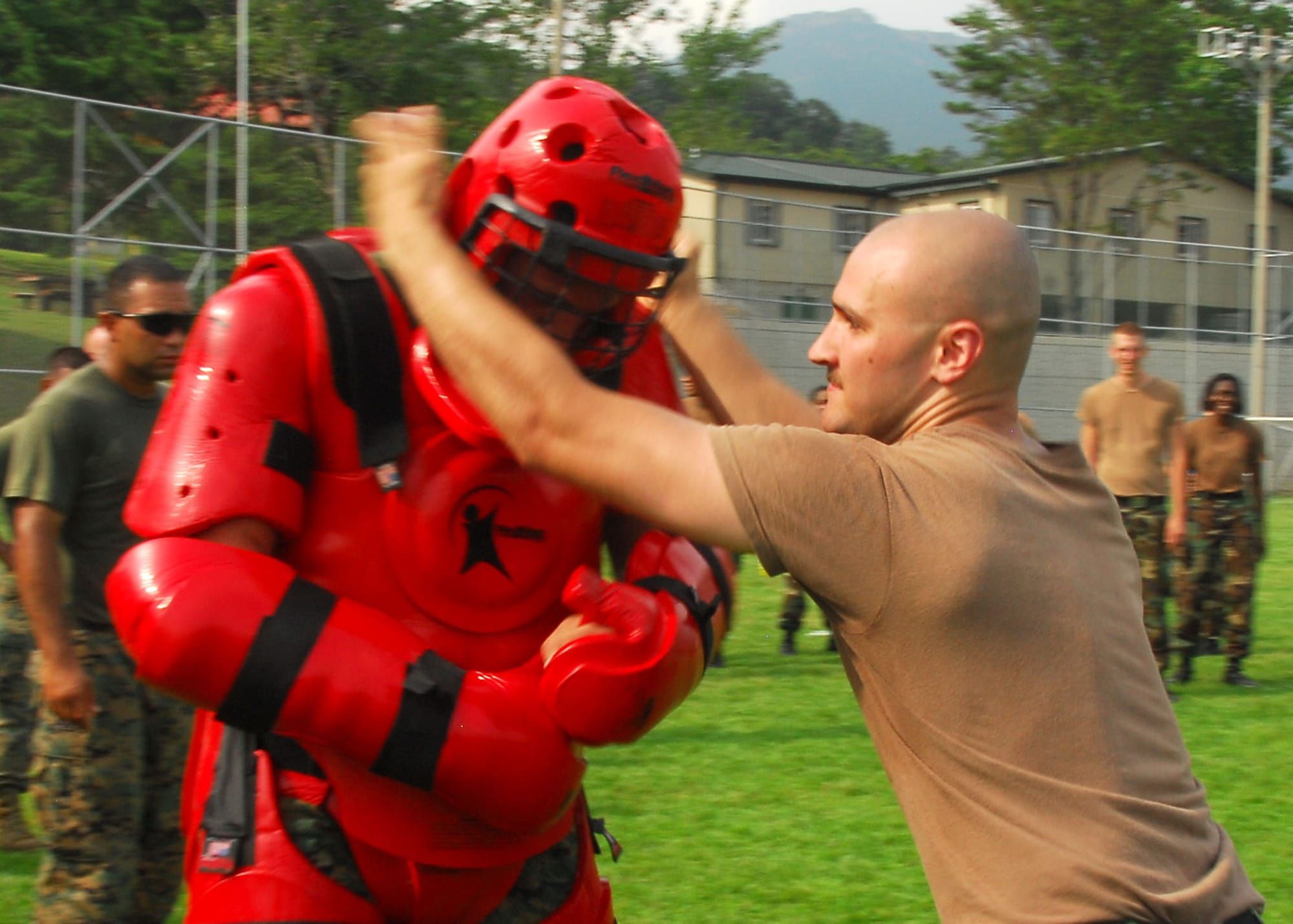
.jpg)
Two of Korea's most respected martial arts, taekwondo and hapkido, sit at opposite ends of the same debate. One trains you to win. The other trains you to survive. Here's what the research says about the gap between them — and why closing it might matter more than picking a side.
Ask a room full of martial artists why they train, and you'll get two answers that sound similar but aren't. Some say they want to win. Others say they want to make it home. Both are legitimate. But dig into the last decade of research on police officers, correctional staff, and soldiers — the people whose training is tested by real violence — and a harder truth surfaces: training for one of those goals does not automatically prepare you for the other. Sometimes it actively works against the other.
Nowhere is that split clearer than in the gap between competitive taekwondo (태권도) and hapkido (합기도), two arts that emerged from the same Korean martial tradition yet ended up almost nowhere near each other.
The Sport That Trains You Away From the Fight
Olympic taekwondo sparring is called gyeorugi (겨루기), and it is, by design, an extremely narrow simulation of violence. Three two-minute rounds. A roughly 8-meter competition area. Points for kicks and punches to a padded trunk protector, with more points for spinning and head kicks — a turning kick to the head is the single highest-value strike in the sport, worth 5 points under the current World Taekwondo rules. Punch someone in the face, grab them, or aim below the waist, and you're not disqualified for brutality — you're penalized for breaking the rules.
That's not a knock on the sport. It's the whole point of a sport: a fair, safe, repeatable contest between two consenting, similarly matched athletes. But it means a gyeorugi competitor's reflexes are drilled, rep after rep, away from the exact moves a self-defense instructor would teach first — eye strikes, throat strikes, groin strikes, and clinch control. Sport-science researchers call this "representative learning design": you get extremely good at whatever your training environment rewards, and that skill doesn't automatically transfer to an environment with different rules — or no rules at all.
Most traditional taekwondo schools know this, which is why they maintain a separate self-defense curriculum — hoshinsul (호신술) — alongside the competitive sparring track. Two black belts from the same dojang (도장) can walk away with genuinely different toolkits, depending on which side of the curriculum they trained.
The Art With No Scoreboard
Hapkido has no Olympic circuit, no belt-division sparring format, and nothing like gyeorugi. Its name roughly means "the way of coordinated power," and its technical language centers on the term hoshinsul — self-defense technique — alongside sool (술), the general Korean word for "technique." It was developed by Choi Yong-Sool from Japanese Daito-ryu Aiki-jujutsu joint locks and older Korean kicking methods, then popularized and named by his student Ji Han-Jae. What you get is joint locks, throws, and strikes to pressure points Koreans call hyeol (혈) — the same points referenced in acupuncture — aimed at whatever target actually works, because there's no scoring sheet to tell you otherwise.
That sounds like the obvious winner for self-defense. It isn't, quite. Because hapkido has no live-opponent competitive format, most of its techniques are drilled against a partner who, to some degree, is cooperating. And research on real-world skill transfer says that's a serious problem in its own right.
What Happens When You Actually Test This
This is where the debate stops being theoretical, because it's already been studied — not among martial artists, but among the people whose jobs depend on getting it right.
A team of Dutch researchers (Koedijk, Renden, Oudejans, & Hutter, published in the journal Ergonomics in 2019) put correctional officers through their self-defense training and then tested them in genuinely resisting, unscripted scenarios — not compliant partner drills. The officers improved. But depending on the specific skill, between 4% and 73% still couldn't reliably execute a technique they'd just been trained in when a real person was fighting back. The researchers' blunt conclusion: self-defense training "must be representative for the work field." Drilling against a partner who's helping you succeed teaches you something — just not necessarily what you think it does.
A related study of police officers (Renden, Savelsbergh, & Oudejans, 2017, also in Ergonomics) found that simple, high-percentage "reflex-based" techniques performed better in simulated high-pressure arrests than more elaborate conventional training — further evidence that complexity is often the first casualty of real stress, not the last.
This aligns with a much older, more informal but widely cited idea in tactical training circles, developed by Bruce Siddle and Dave Grossman: as your heart rate spikes under genuine threat, fine motor skills go first, then complex motor skills, until only the simplest, most heavily rehearsed gross-motor patterns remain reliably available. It's worth saying plainly that this specific heart-rate model has been criticized within the tactical training world for being oversold as harder science than it really is — but the underlying pattern (complexity collapses under stress) appears consistently enough in the peer-reviewed research above to be a reasonable working assumption, not just tactical folklore.
Put those two threads together, and you get a clear explanation for why both taekwondo's sport curriculum and hapkido's self-defense curriculum are, on their own, incomplete: gyeorugi gives you live resistance but a narrowed target list; hoshinsul gives you the full target list but rarely tests it against someone who is actually trying to stop you.
The Army Already Had This Argument — And Solved It
Here's the part that should settle any lingering "which is better" debate: an institution that deals in actual, unscripted violence for a living already encountered this exact problem and resolved it in doctrine.
When Sergeant First Class Matt Larsen was tasked with rebuilding the U.S. Army's hand-to-hand combat program in 1995 — a project that became the Modern Army Combatives Program — he ran straight into the taekwondo problem. In his own words, on the record: "competitors will focus their training on winning and therefore only train the techniques that are allowed in competition." Rather than throwing out competition, he built a system of graduated rule sets — soldiers move through progressively less restrictive competitive formats, so no single scored rule set becomes the only thing their bodies know how to do.
Marine Corps doctrine (MCRP 3-028) takes a related approach, structuring its martial arts program around three simultaneous tracks — mental, character, and physical — on the theory that technique without decision-making under stress isn't combat-ready. And current Army commentary is blunt about the other half of the equation: hand-to-hand skill "deteriorates" without a living training culture behind it — echoing exactly what the correctional-officer research found about skills that are certified once and never pressure-tested again.
In other words: the people whose job is real violence didn't pick a side between "sport" and "self-defense." They built a system that cycles between both, on purpose, because either one alone produces a predictable, documented failure mode.
So, Which Should You Train?
Taekwondo, trained competitively, gives you:
- A live, fully resisting opponent — the hardest thing to replicate any other way
- Real conditioning under time pressure, fatigue, and an audience present
- A narrowed target list that won't include the moves that actually end a street fight quickly
Hapkido, self-defense-focused, gives you:
- An unrestricted technical range — joints, pressure points, throws, whatever the situation requires
- Techniques designed from day one for grabs, holds, and close range, not for a squared-off opponent
- A near-total absence of live-resistance testing that tells you whether any of it actually works under pressure
Neither gap closes itself. The evidence — from correctional officers, police, and the Army's own doctrine — points to the same fix: don't treat sparring and self-defense drilling as competing philosophies. Treat them as two halves of the same unfinished job. Many schools already do this quietly, running gyeorugi and hoshinsul as parallel tracks in the same dojang, or having students cross-train — a hapkido practitioner adding live sparring somewhere, a taekwondo competitor sitting in on hoshinsul seminars for the targets the scoreboard doesn't reward.
The debate over which art is "more real" misses the key finding buried in all this research: you respond as you train, full stop. The only real question is whether what you've trained is complete — and per the data above, for most people training just one half of this equation, it probably isn't.
Sources
- Koedijk, M., Renden, P. G., Oudejans, R. R. D., & Hutter, R. I. V. (2019). Training for the job: Evaluation of a self-defence training programme for correctional officers. Ergonomics, 62(12), 1585–1597. https://doi.org/10.1080/00140139.2019.1677947
- Renden, P. G., Savelsbergh, G. J. P., & Oudejans, R. R. D. (2017). Effects of reflex-based self-defense training on police performance in simulated high-pressure arrest situations. Ergonomics, 60(5), 669–679. https://doi.org/10.1080/00140139.2016.1205222
- Renden, P. G., Nieuwenhuys, A., Savelsbergh, G. J. P., & Oudejans, R. R. D. (2015). Police officers' preparation and performance of their arrest and self-defense skills: A questionnaire study. Ergonomics, 58(9), 1–17. https://doi.org/10.1080/00140139.2015.1013578
- Staller, M. S., Abraham, A., Poolton, J., & Körner, S. (2018). Avoidance, de-escalation and attacking: An expert coach consensus on the composition of self-defense training. Journal of Physical Education and Sport Sciences, 11, 213–214.
- Cynarski, W. J. (2017). Towards a general theory of fighting arts. Physical Activity Review, 5, 83–90.
- Siddle, B. K., & Grossman, D. Effects of combat stress on performance [tactical-training monograph]. http://www.combatconcepts.info/uploads/4/6/6/4/4664213/effects_of_combat_stress_on_performance.pdf — and for the critical counterpoint on this model's precision, see Practical Self-Defense (2014), "The Stay Alive Program: Death to the heart rate chart," http://practicalsd.blogspot.com/2014/07/death-to-heart-rate-chart.html
- Hand to hand combatives in the US Army [Army research monograph]. Defense Technical Information Center (DTIC). https://apps.dtic.mil/sti/pdfs/ADA511484.pdf
- Marine Corps martial arts program (MCRP 3-028). United States Marine Corps. https://info.publicintelligence.net/USMC-MCMAP.pdf
- United States Army Combatives School. In Wikipedia. https://en.wikipedia.org/wiki/United_States_Army_Combatives_School
- Army.mil (2025). The Army combatives program: An underutilized tool for commanders. https://www.army.mil/article/282420/the_army_combatives_program_an_underutilized_tool_for_commanders
- World Taekwondo tournament rules and current point values (verified against three independent official/current sources): Amateur Athletic Union, 2024–2025 AAU Taekwondo Handbook, https://image.aausports.org/dnn/tw/2025/2025AAUTKDHandbook-9.1.24.pdf; Government of Ontario, "Amateur Combative Sport Rules – Taekwondo," https://www.ontario.ca/document/amateur-combative-sport-rules-taekwondo/part-iv-competition-requirements; NBC Olympics, "Olympic Taekwondo 2024 rules and scoring," https://www.nbcolympics.com/news/taekwondo-101-olympic-rules-regulations-and-scoring
- Korean terminology and hapkido history: Eagle Martial Arts, "Overview: About Hapkido," https://www.eaglemartialarts.com.au/about-hapkido-overview/; Lee's Martial Arts, "History of Hapkido," https://www.leesbloomington.com/history/history-of-hapkido/; Korean martial arts, Hapkido, and Dojang, Wikipedia; Taekwondo Preschool, "World Taekwondo (WT) Tournament Point System," "Hapkido 합기도," and "Dojang 도장 (Training Hall)," https://www.taekwondopreschool.com