Taekwondo: How an Athlete Gets a Spot for Olympic Gold
Here is how a Taekwondo athlete goes from student to gold medalist.
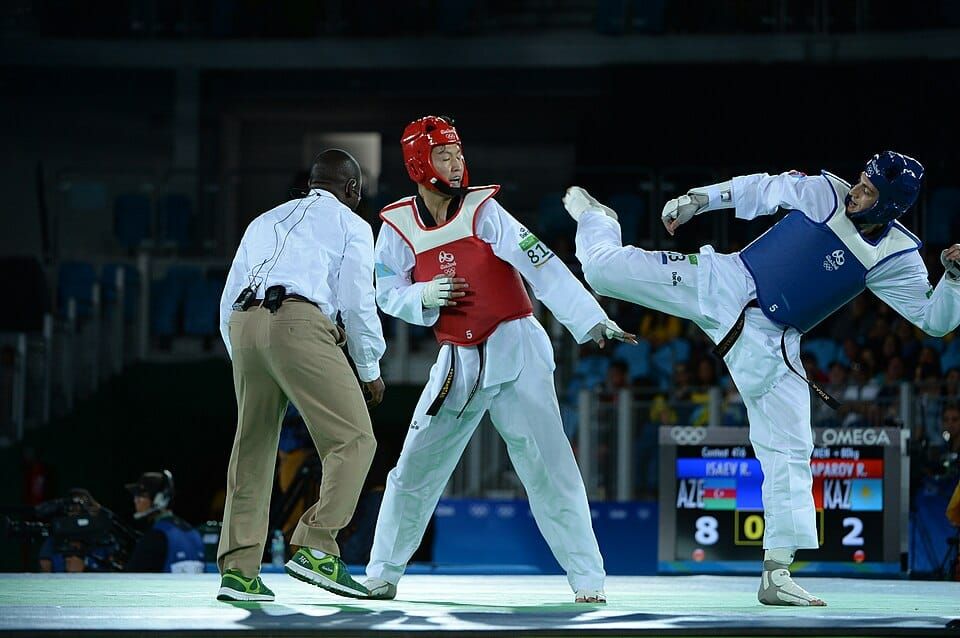
It begins with falling in love with the sport. For most elite competitors, training starts young — commonly between ages four and seven — though this stage is emphatically not about winning. Ironically, the most competitive young children are the most likely to burn out and quit by their teens if pushed too hard, too early. The first years are about fundamentals and enjoyment: basic kicks, stances, balance, dojang etiquette, and steady progress through the colored belts. If there is competition, it should be low-pressure and fun.
Then comes the building of a competitor. As fundamentals solidify — usually in what is called the Youth division, roughly ages five to eleven in organized competition — training shifts toward supervised sparring in full protective gear: footwork, timing, judging distance, and controlled contact. Volume matters at this stage. Frequent competition teaches a young athlete to manage nerves and perform under pressure. In the United States, a large amateur circuit run by the AAU (the Amateur Athletic Union, a long-established organization that oversees youth sports of many kinds) offers numerous accessible tournaments to gain experience, while flexibility and conditioning help build an athletic base.
The pivotal milestone is the black belt — not just any black belt, but a first-degree rank certified by the Kukkiwon, typically earned between ages nine and thirteen. This is what unlocks the serious competitive ladder. Around this point, an athlete usually joins a dedicated competition or sparring team and begins competing in sanctioned championships — tournaments officially recognized by the sport's governing bodies, whose results count toward formal rankings and qualification. These sanctioned state-level events are the official gateway to the national system.
Next is the national stage. Competition is organized by age into divisions. The two divisions that bridge youth competition and the senior elite are the Cadet division (ages 12–14) and the Junior division (ages 15–17). In the United States, the path runs through USA Taekwondo (USAT), the national governing body — the official organization responsible for the sport in the country. USAT runs the national championships and selects the athletes who represent the U.S. internationally. USAT operates a points-based ranking and selection system: strong results at designated major tournaments, plus performance at Team Trials (a selection event where the country's top athletes compete head-to-head for national-team spots), determine who earns a place on a U.S. National Team. Making a Cadet or Junior National Team is the first time an athlete officially represents the United States — a major and realistic target in its own right. (It is worth noting that AAU and USAT are separate circuits: AAU is a superb training ground for early experience and a high volume of matches, while USAT is the official road to the national team and the Olympics. Many young athletes do both, with the balance shifting toward USAT as they climb.)
Then the world opens up. Cadet and Junior World Championships, regional events like the Pan American Championships (the championship for the Americas), and large open international tournaments such as the U.S. Open expose athletes to unfamiliar styles and the pressure of global competition. Results at these graded events begin to build the ranking history that will prove decisive later.
Finally, the senior elite circuit begins. From the year an athlete turns 17, they become eligible for the Senior division — the adult, Olympic-level division — and for the global circuit of major events run by World Taekwondo, including the season-long Grand Prix, the elite Grand Slam, and the senior World Championships. This is where the single most important currency in Olympic qualification is earned: the World Ranking, a running list of the best athletes in each weight class, built by placing well at these graded international events. Reaching this level is effectively a full-time pursuit, often involving relocation to a high-performance training center and close work with the national program.
The Final Climb: Earning an Olympic Spot
Qualifying for the Olympics has two layers, and the distinction often surprises newcomers.
The first layer is earning a "quota place" — and a quota place belongs to a country, not to an individual athlete. A quota place is simply a slot at the Games allotted to a nation in a particular weight class. The main way a country earns one is through the World Ranking: the top-ranked athletes in each Olympic weight category secure a quota for their nation, rewarding sustained world-class results over the multi-year qualifying period. There are a few additional routes — special elite events and regional qualifying tournaments (for Americans, the Pan American Olympic qualifier) — plus a small number of places reserved for the host country and for nations with few athletes. (As host of the 2028 Los Angeles Games, the United States holds a host-nation allocation, a meaningful advantage for that cycle.)
The second layer fills that spot. Because the quota belongs to the country rather than the athlete who helped earn it, USA Taekwondo then applies its published selection procedures — generally a combination of ranking and Team Trials — to determine which American competes in that weight class at the Games. An aspiring Olympian therefore has to do two things: help earn the quota through international results and then win the domestic selection process for it.
This is where that 2000 Sydney decision returns with full force. With only four weight classes per gender, and each country permitted at most one athlete per Olympic weight class — a maximum of four men and four women for the entire nation — making the U.S. team does not merely mean being a strong competitor. It means being the single best American in your weight category at exactly the right moment. Beneath it all are two firm requirements for every Olympic taekwondo athlete: a Kukkiwon black-belt certificate and a valid competition license issued by World Taekwondo (essentially official registration that allows an athlete to compete in sanctioned international events).
Why the Foundation Quietly Decides Everything
That Kukkiwon requirement is the thread that ties the elite summit back to the very first lesson. Because rank in Olympic taekwondo is certified by the Kukkiwon, the standard a child trains under from day one genuinely matters. An athlete who spends years earning rank under an unrecognized standard may have to start over under the system that actually counts. The foundation is not a generic preliminary; it is the base of the same structure that extends all the way to the Games.
This is why the choice of a first school — and the credentials of its instructors — deserves serious attention. A few questions can tell a parent most of what they need to know. Is the school's rank issued under the Kukkiwon system or another standard? A Kukkiwon-certified black belt is recognized worldwide and is the credential every Olympic-track athlete must ultimately hold, so training under that standard from the start avoids having to start over later. What is the lead instructor's documented lineage — can they trace their training back through a clear line of recognized teachers, and do they hold a verifiable grandmaster-level rank? Decades of personal competition or coaching experience, ideally with athletes who have competed at the state, national, or international level, are also a meaningful signal. None of this guarantees a future Olympian — most young athletes, even excellent ones, will not reach that summit, and that is fine — but it does mean a child is building rank and skill on a foundation that will count if their ambitions grow.
A Direction, Not a Destination
The road that began in a Seoul stadium in 1988 ends, for the overwhelming majority who set out on it, short of the Olympic podium. The United States sends at most four men and four women to the Games, selected from tens of thousands of competitors. Reaching that level demands talent, years of disciplined work, family support, and a measure of luck. Most who aim for it will not arrive. That is normal, not failure.
It is still worth the journey because the path rewards athletes at every stage. State champion, national qualifier, member of a national team, college competitor, lifelong martial artist with the focus and resilience the training builds — these are real and valuable outcomes, earned whether or not the final summit is ever reached. The same training that forges an Olympic hopeful also forges a stronger, more disciplined young person.
Taekwondo's history is the best argument for this mindset. A fragmented set of post-war training halls became a unified national art; a stadium demonstration became a permanent Olympic sport; a regional discipline became the practice of a hundred million people. None of that happened in a single leap. It happened through patient, cumulative effort, one step building on the last. The path to the Olympics works the same way — and for a beginner standing on the mat today, learning to bow, that first step is the only one to take right now.