The Dance That Fights Back: Inside Taekkyon, Korea's Nearly Lost Martial Art
How a village game survived colonization, near-extinction, and a 20th-century myth-making machine — and what it really has to do with Taekwondo
How a village game survived colonization, near-extinction, and a 20th-century myth-making machine — and what it really has to do with Taekwondo
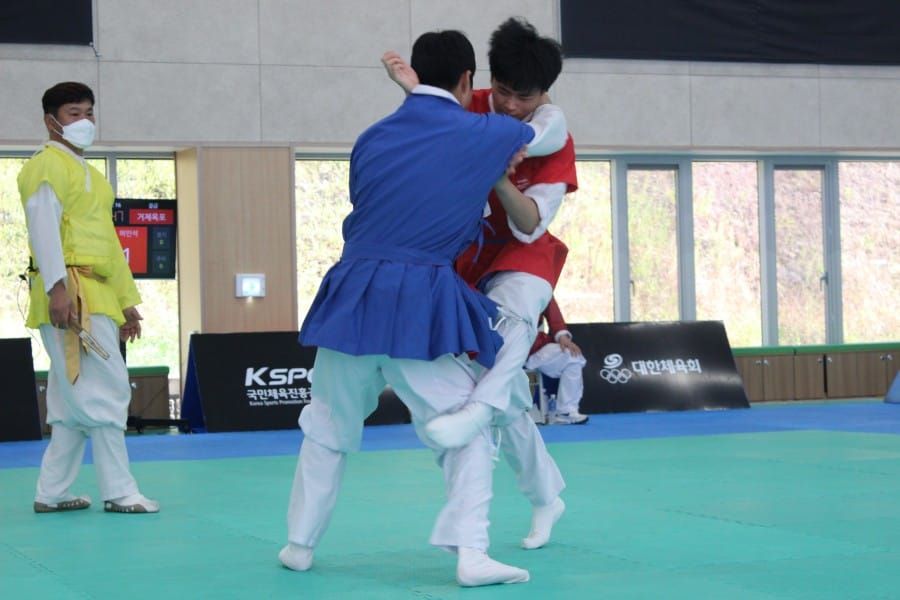
There is a moment in old Taekkyon footage that never fails to catch newcomers off guard. Two men circle each other, swaying, almost giggling, feet tracing a lazy triangle in the dirt. It looks like a folk dance. Then, without warning, one man's leg sweeps low, and the other is on his back in the dust — grinning.
That contradiction is the whole story of Taekkyon: a martial art so gentle-looking it was once dismissed as a children's game, and so effective that it quietly shaped the identity of the most popular martial art on Earth. Or did it? That second question turns out to be far more complicated — and more political — than most people realize.
A Game as Old as the Village Square
Taekkyon's roots reach back centuries into Korean folk life, though — as with most oral, community-based traditions — nailing down a precise origin is nearly impossible. The earliest written references to something resembling Taekkyon appear during the Joseon Dynasty, with historical texts describing it as a form of hand-to-hand contest practiced "like today's Taekkyon" as far back as the late 1700s. Some scholars trace visual echoes of its stances even further, into folk paintings and older combat depictions.
What's clearer is how it was practiced. During the Joseon period, Taekkyon existed in two parallel forms: a martial form used by soldiers and a much more widespread recreational form played by ordinary people — often alongside ssireum (Korean wrestling) at festivals like Dano and Chuseok. Entire neighborhoods would field teams. Seoul's practitioners were even informally divided by geography: the Widaepae (윗대패), who lived inside the old city walls, and the Araedaepae (아랫대패), from outside them — rival factions who would test each other's skill at seasonal tournaments.
It was democratic in the truest sense. Court records describe the king's own household engaging with it, while it was simultaneously a beloved pastime of farmers and laborers. But that same folk-game reputation would later work against it. As Neo-Confucian values tightened their grip on the Joseon elite — prizing scholarship and looking down on physical, "lowborn" pursuits — Taekkyon slid out of favor with the upper classes. By the turn of the 20th century, it survived mainly in and around Seoul's Jongno district, a shadow of its former reach.
Then came the occupation.
Extinguished in Public, Kept Alive in Secret
When Japan annexed Korea in 1910, colonial authorities moved swiftly against anything that smacked of indigenous Korean identity — language, customs, and martial traditions among them. Public gatherings were restricted, and native fighting arts were actively suppressed, partly because they were associated with the kind of communal rowdiness (gambling, street contests) that colonial police found easy to criminalize.
For most of Korea's native martial systems, this period was fatal. Taekkyon barely survived it, kept alive by small numbers of practitioners training away from official scrutiny. One of them was a boy from Seoul's Sajik-dong neighborhood named Song Deok-gi.
Song had begun training at age twelve under a locally renowned master, Im Ho, learning in a quiet glade on the slopes of Inwangsan mountain. He trained under Im Ho for over a decade, continuing even after his master's death — and when the occupation made open practice dangerous, Song kept going in private. By the time Korea emerged from Japanese rule in 1945 and then endured the devastation of the Korean War, Song Deok-gi was, for all practical purposes, the only person left alive who could teach authentic Taekkyon.
One Man, One Demonstration, One Fragile Thread
Song's re-emergence into public life came almost by accident. In 1958, he performed a martial arts demonstration for President Syngman Rhee's birthday — the first public appearance of Taekkyon in decades. It earned him a nickname that stuck for the rest of his life: "the Last Taekkyon Master of the Joseon Dynasty."
But recognition didn't equal revival. Korea in the late 1950s and '60s had eyes for something else entirely: a fast-rising, internationally minded martial art called Taekwondo was capturing the imagination of a generation rebuilding a shattered country. Taekkyon, by comparison, looked antique — a curiosity from a Korea that no longer existed.
Song kept teaching anyway, largely alone, to a small, devoted handful of students through the 1960s and '70s. Two of his earliest and most important disciples, Lee Jun-seo and Ko Yong-woo, would go on to carry his particular lineage — known as Widae Taekkyon, after his home village — into the next century. Around the same time, a physical education teacher named Shin Han-seung became one of the driving forces behind formally documenting and modernizing the art, working to secure it official recognition.
Their efforts paid off. On June 1, 1983, the South Korean government designated Taekkyon as an Important Intangible Cultural Property No. 76 — placing it in an extremely small club of Korean traditions granted that protection, alongside ssireum wrestling and traditional archery. Song and Shin were named Living National Treasures.
It should have been a triumphant final chapter. Instead, tragedy struck almost immediately: Song Deok-gi died in July 1987, and Shin Han-seung followed just twenty days later. Their near-simultaneous deaths — and disagreements between their respective students over how faithfully to preserve versus modernize the art — split the Taekkyon world into competing schools that persist to this day: some fiercely traditionalist, others more focused on turning Taekkyon into an internationally competitive sport.
The art's final vindication came in November 2011, when UNESCO inscribed Taekkyon on its Representative List of the Intangible Cultural Heritage of Humanity — the first martial art in the world to receive that honor. The nearly-extinguished village game had officially become a treasure of humanity.
What Taekkyon Actually Looks Like
Strip away the history, and Taekkyon is genuinely unlike almost anything else in the martial arts world. Its foundation is a triangular stepping pattern called pumbalgi—a constant, rhythmic sway that resembles a dance and gives the whole art its hypnotic, musical quality. Practitioners describe it as producing a distinctive, bouncing "ek-ek" sound as they move.
From that swaying base come low, sweeping kicks and trips designed to unbalance an opponent rather than smash through them, along with open-hand pushes, shoves, and — depending on the lineage — joint locks and grappling. Traditional matches historically emphasized throwing an opponent to the ground rather than striking with damaging force; some schools' sport rule sets today award points for throws, ring-outs, and head kicks while forbidding hand strikes and headbutts entirely. It's a martial art built around deception and timing rather than raw power — using an opponent's own momentum and misdirection to do most of the work.
So — Is Taekkyon Really Taekwondo's Ancestor?
This is where things get genuinely contentious, and where popular belief and academic history sharply diverge.
The story most people have heard goes like this: Taekwondo is an ancient Korean martial art, thousands of years old, and Taekkyon is its direct ancestor — the folk root from which the modern sport eventually grew. This version has been repeated in Taekwondo textbooks, promoted by national sporting bodies, and even influenced the choice of the name "Taekwondo" itself, which was selected partly as a deliberate echo of "Taekkyon."
The documented history tells a messier, more interesting story. Taekwondo was created in the 1940s and '50s by Korean martial artists organized into competing schools known as the "Nine Kwans" — many of whose founders had trained not in Taekkyon, but in Japanese Shotokan karate, often while living or studying in Japan during the colonial period. Scholars researching the era's original training manuals have found something striking. While those early manuals claim descent from an ancient Korean fighting art, none of them actually document or demonstrate a single recognizable Taekkyon technique. The technical content — stances, forms, terminology structure — traces overwhelmingly to karate, not to Taekkyon.
Why the false lineage, then? Timing offers a clue. After liberation from Japan, anything associated with the former colonizer was politically toxic — including a martial art that was, in its bones, Korean-practiced karate. Constructing a purely indigenous origin story solved that problem neatly, and it dovetailed with a broader postwar push (accelerated under the Park Chung-Hee government of the 1960s–70s) to give Korea a martial art with unimpeachable, ancient national credentials. Academic historians studying this period — a small but serious field within Korean studies — now frame it as a textbook example of what scholars elsewhere call an "invented tradition": a practice presented as ancient heritage that is, in fact, a comparatively recent creation shaped by the political needs of its own moment.
There's even a colorful founding anecdote that captures the confusion at the heart of the myth: in 1952, President Syngman Rhee reportedly watched a demonstration by Korean army officers and mistook it for genuine Taekkyon. This misidentification helped push the officers toward adopting a name and origin story evoking that older art, even though the techniques on display were fundamentally karate.
So what's the honest verdict? Most serious historians today land on a middle position, and it's worth stating precisely: Taekwondo is not technically descended from Taekkyon. Its stances, forms, and core technical DNA come from Shotokan karate. But Taekkyon likely did exert a real, if narrower, influence — chiefly by inspiring Taekwondo's signature emphasis on high, powerful, wide-ranging kicks. This stylistic direction set it apart from karate's more hand-centric approach and gave the new art something to call distinctly its own. The name itself and the desire to be seen as authentically Korean rather than a repackaged Japanese import owe something to Taekkyon's cultural memory — even if the movements in the dojang do not.
There's a fitting irony in how tangled the fates of these two arts became. Some of the very people who kept Taekkyon alive in its darkest years — Do Ki-hyun and Lee Yong-bok among them — arrived at Song Deok-gi's door as curious Taekwondo practitioners, having heard the popular myth and gone looking for its supposed source. In trying to verify a legend, they ended up saving the truth it had obscured.
The Legacy Today
Modern Taekkyon exists across several organizations — the Widae Taekkyon Preservation Society (rooted directly in Song's lineage), the Korea Traditional Taekgyeon Association, and the larger, more sport-oriented Korea Taekkyon Federation, among others — each balancing preservation against the pressures of modernization in its own way. Practiced today in Korea and increasingly abroad, from the U.S. to Europe to Australia, it remains what it always was underneath the swaying footwork and easy grins: a martial art that survived by being underestimated, and that continues to reward anyone willing to look past its playful surface.
Sources consulted include peer-reviewed work by Steven D. Capener (Korea Journal), Eric Madis, and Udo Moenig; Cho, Moenig, and Nam's Taekkyon-focused study in Acta Koreana; Alex Gillis's "A Killing Art"; and UNESCO's Intangible Cultural Heritage documentation. Image By Hk8995 - Own work, CC BY-SA 4.0, https://commons.wikimedia.org/w/index.php?curid=117363530