The MOO DUK KWAN 무덕관 and Tang Soo Do 당수도 - Part II
The Art's Technical Identity: What Was Tang Soo Do Moo Duk Kwan?
Editor's note: This is a multipart series on the documented history of origin, identity, divergence, and legacy of The Moo Duk Kwan and Tang Soo Do.
Part I: Etymology and Early Identity: What Does "Tang Soo Do" Mean?
Part II - The Art's Technical Identity: What Was Tang Soo Do Moo Duk Kwan?
Composition and Curriculum
Hwang Kee described the composition of his art in his writings. According to his account, Tang Soo Do Moo Duk Kwan was composed of approximately 60% Korean traditional martial arts (primarily Soo Bahk Do, the ancient Korean art), 30% Northern Chinese Kung Fu (the techniques he claimed to have studied under Master Yang Kuk Jin in Manchuria), and 10% Southern Chinese Kung Fu — with Okinawan Karate woven throughout, particularly in the classical forms (hyung) borrowed from the Shotokan tradition.
This blended composition was reflected in the curriculum. The foundational forms of Tang Soo Do Moo Duk Kwan were the Kicho (basic) forms, followed by the Pyung Ahn series (known in Japanese Karate as Pinan/Heian), Bassai, Naihanchi, Sip Soo, Rohai, and Kong Sang Koon — all rooted in the Okinawan Karate tradition. These were adapted and Koreanized, yet their Shotokan heritage remained clear. This is why Hwang Kee's art, like most other post-liberation Korean kwans, drew heavy criticism for being essentially Korean-flavored Karate rather than an indigenous Korean art.
The Midnight Blue Belt: A Defining Symbol
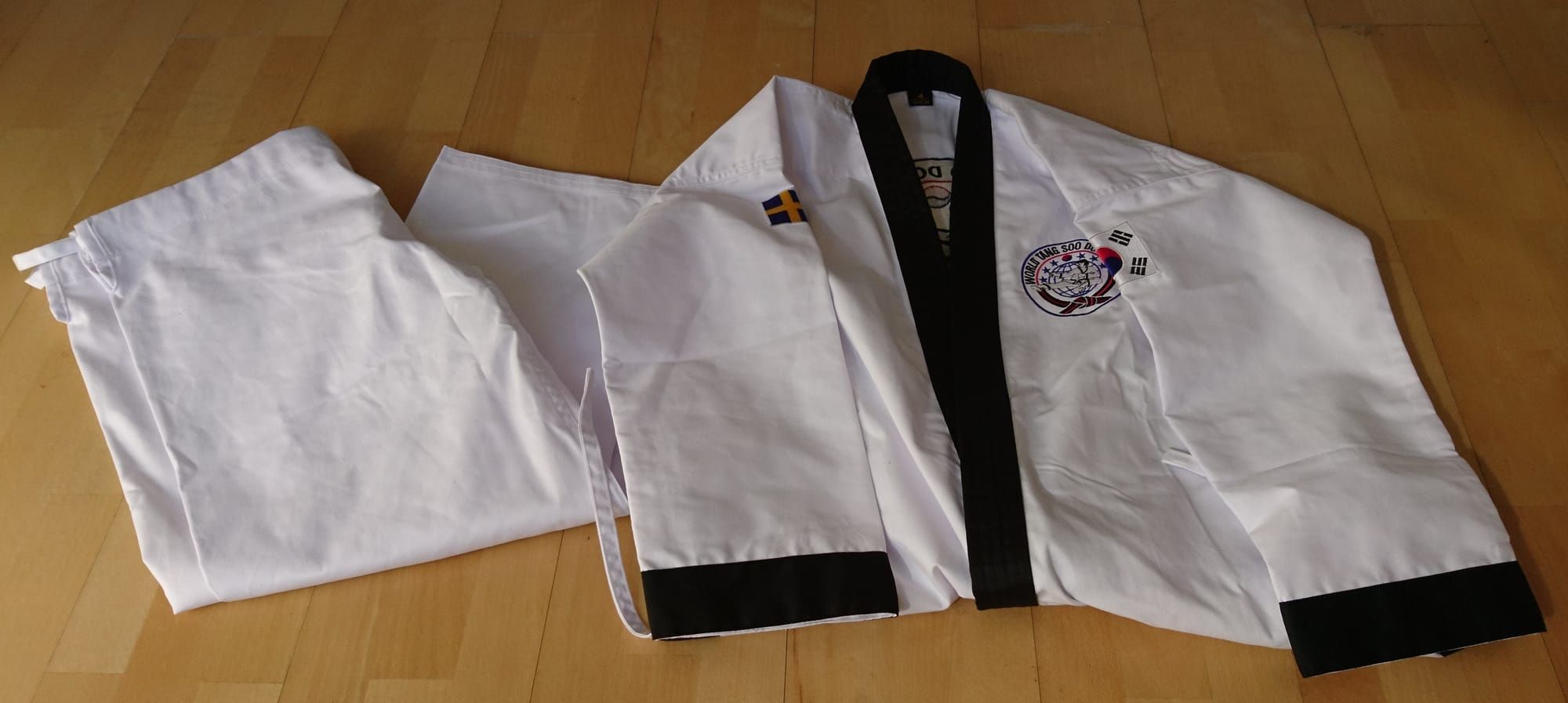
One of the most distinctive and philosophically significant markers of Moo Duk Kwan Tang Soo Do was its use of a midnight blue belt rather than a black belt to denote dan (black belt equivalent) rank. Hwang Kee instituted this tradition based on a belief rooted in Korean cultural philosophy: black represents perfection and finality — the end of learning. Since no practitioner can ever be perfect and the martial arts journey never truly ends, Hwang Kee rejected black as an appropriate symbol for advanced rank.
Instead, midnight blue — the deep color of the night sky, associated with depth, humility, and perpetual growth — was chosen. In Tang Soo Do philosophy, black "cannot become darker," implying stasis, whereas midnight blue "represents more positive concepts, such as the element of water" — fluid, adaptive, and always moving. This tradition persists in official Moo Duk Kwan/Soo Bahk Do schools, where practitioners at 4th dan and above wear midnight-blue belts with a central red stripe. Many independent Tang Soo Do schools that trace their lineage to Moo Duk Kwan also retain this tradition, though it is not universal — many use black belts.
The Hyung (Forms) Curriculum
The hyung (forms) curriculum of Tang Soo Do Moo Duk Kwan underwent significant evolution during Hwang Kee's lifetime, and this evolution became one of the primary technical fault lines separating those who remained with Hwang Kee from those who left.
The original "classical" curriculum consisted of forms common to many kwan traditions: Kicho Il Bu, Ee Bu, and Sam Bu (basic forms); Pyung Ahn Cho Dan through Oh Dan (the five Pinan/Heian series); Bassai; Naihanchi; Sip Soo; Rohai; Kong Sang Koon; and others. These forms were shared across multiple kwans in various iterations and clearly reflected Shotokan Karate’s ancestry.
Hwang Kee then developed two entirely new form sets with no precedent in any other martial art. The Chil Sung Hyung (seven star forms), created in 1952, were unique to the Moo Duk Kwan — structured around the alternation of Um and Yang (soft and hard), with the Seven Stars (Chil Sung) serving as a philosophical metaphor for guidance and orientation. The Yuk Ro Hyung (six path forms), developed after Hwang Kee's 1957 discovery of the Muye Dobo Tongji, drew directly from the ancient Korean military text's Kwan Bup section.
The Hyung Divide — A Key Technical Marker
Schools practicing the Chil Sung and Yuk Ro hyung sets, in addition to the classical Japanese-derived forms, represent the official Moo Duk Kwan lineage (Soo Bahk Do) or schools that remained closely connected to it. Schools that teach only the classical Kicho, Pyung Ahn, Bassai, Naihanchi, and related forms represent the "older" Tang Soo Do tradition — the curriculum as it existed before Hwang Kee's Soo Bahk Do developments. Many Tang Soo Do organizations today teach some combination of both sets. This is the clearest single technical marker distinguishing the various Tang Soo Do lineages from one another.
In Part III: The Renaming: From Tang Soo Do to Soo Bahk Do (1957–1995)