The Quiet Blade: Understanding Korean Sword Meditation
Gumdo (검도), often called "the way of the sword," is a Korean family of sword arts with deep roots in military history. Modern sport Kumdo has a more recent, direct link to Japanese kendo.
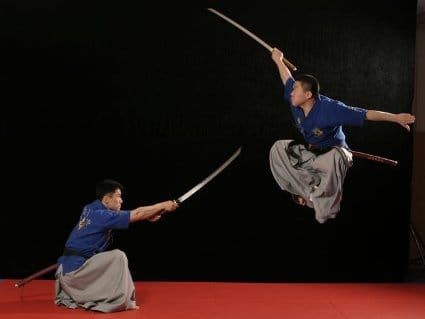
Introduction
Gumdo (검도), often called "the way of the sword," is a Korean family of sword arts with deep roots in military history. Modern sport Kumdo has a more recent, direct link to Japanese kendo. Although they share techniques, uniforms, and some vocabulary, Korean Kumdo has developed its unique character over the last century. This includes native terminology, distinct forms, and a focus on the meditative and internal aspects of swordsmanship, which many practitioners see as central. For them, the sword is more than just a weapon or sport; it's a tool for cultivating calmness, clarity, and self-control. The core of Gumdo sword meditation is a practice where cutting movements and a silent mind are intertwined.
It's important to acknowledge something often overlooked: Gumdo's meditative terminology isn't an isolated, self-contained set of words. Like most Korean martial philosophies, it incorporates elements from Buddhist meditation practices, breathing techniques common in Hapkido, Taekwondo, and other sword disciplines, as well as Sino-Korean philosophical ideas also found in Japanese Budo. This blend isn't a flaw — it shows how Korean martial arts genuinely evolved — but it means some concepts are meant to be understood as relevant to Gumdo specifically, rather than as entirely unique to it.
The Philosophy Behind the Blade
Gumdo centers on a paradox typical of meditative martial arts: achieving controlled and decisive actions requires a calm, focused awareness. Its roots in Korean swordsmanship are influenced by Confucian discipline, Buddhist mindfulness, and a cultural reverence for ritual and spirit. These influences foster the idea that a sword strike reveals the true state of the mind behind it. Thus, a restless, anxious mind leads to a shaky, uncertain cut, while a calm, settled mind results in a clean, precise strike.
Instructors often describe the sword as a mirror, not only cutting the air but also reflecting the practitioner's inner state directly and honestly. In this view, meditation isn't a separate task to do before or after training; instead, it's integrated into the stance, breathing, and the act of cutting itself.
Breath as the First Movement
Before executing a cut, Gumdo training usually emphasizes breathing. Many schools practice danjeon hoheup (단전호흡), which involves deep abdominal inhalations focused on the danjeon—the body's energy center located a few inches below the navel. This breathing practice is well-documented in Hapkido and Taekwondo teachings and is not exclusive to Gumdo. In various Korean sword systems, it forms a common base for martial breath training rather than being specific to a particular art.
The rhythm typically follows a simple pattern.
- Inhale to gather energy and awareness, usually when raising the sword.
- Pause temporarily at the moment of peak readiness, where mind and body synchronize.
- Exhale directly through the cut, combining breath release and intention in one smooth action.
This rhythm reflects the tension-and-release cycle common in various Korean and East Asian practices, such as calligraphy and archery, where the action is seen as the result of a prolonged internal process rather than a standalone event.
Stillness Through Static Practice
Many Kumdo schools include extended stance-holding, where practitioners hold a ready stance with the sword up or extended for an extended time, breathing slowly and observing the mind. Since this isn't a standardized drill with a universal name across all Kumdo traditions, it is described here in general terms rather than with a specific technical label.
It accomplishes several things at once:
- Physical conditioning— the isometric strain enhances muscular endurance necessary for maintaining combat readiness.
- Mental discipline involves managing the discomfort of stillness, which can lead to impatience, doubt, and distraction. Observing and releasing these reactions helps the practitioner develop control.
- Symbolic training—a sword held steadily symbolizes a mind maintained in calmness.
Instructors frequently observe that beginners shake not due to weak arms but because of a restless mind. As practice progresses, the blade becomes steadier — mainly because of increased mental calm rather than physical strength.
Forms as Moving Meditation
Beyond stillness, Gumdo incorporates prescribed sword forms called geombeop (검법), meaning "sword method,' which serve as moving meditation. In modern Korean Kumdo, the main curriculum usually features two forms absent in Japanese kendo: Bonguk Geombeop (본국검법) and a standardized set known as Joseon Sebeop (조선세법). These are used for rank promotion under the Korea Kumdo Association and are based on older Korean swordsmanship manuals, notably the eighteenth-century Muyedobotongji. In addition to these historically rooted sets, many Kumdo schools practice a group of forms derived from kendo kata, but with Korean names and terminology instead of the originals. Styles like Haidong Gumdo have their own extensive collections of battlefield-themed forms.
Each form consists of a sequence of cuts, blocks, and steps executed with complete accuracy and concentration. Unlike free sparring, practicing forms eliminates an opponent's unpredictability, enabling the practitioner to focus wholly inward—on posture, breathing, timing, and the refinement of each movement.
Practitioners describe effective technique as having teum eopda (틈 없다) — meaning "no gap" — indicating there's no space in the movement or the mind for hesitation or distraction. This concept aligns with Japanese sword traditions' suki ga nai ('no opening") and echoes the broader East Asian idea of musim (무심), or "no-mind" — action that occurs seamlessly without conscious thought. Musim shares its roots with the well-known Japanese term mushin, highlighting shared Sino-Korean and Sino-Japanese philosophical vocabulary rather than a direct linguistic borrowing.
The Role of the Kihap
Anyone familiar with Korean sword practice has heard the sharp, explosive kihap (기) shout, typically uttered at or just before a strike. The term merges 'ki' (기) — meaning energy or life force — with 'hap' (합) — which means to gather, unite, or coordinate. In this context, kihap refers to the focused energy itself, with the shout serving as its audible expression rather than an end goal.
In meditative terms, the kihap signifies the precise release of internal energy — not too early, which wastes power, nor too late, which leads to hesitation. Mastering the timing and control of the kihap is, in essence, learning to identify the exact moment when internal stillness should transition into external action.
Cutting as Self-Confrontation
One of the most notable features of Gumdo meditation is its function as a means of self-reflection. The sword’s immediate and honest feedback prevents practitioners from avoiding acknowledgment of their mental condition during practice. Fear manifests as withdrawal. Anger appears as reckless, unrestrained strikes. Overconfidence reveals itself through careless form that lacks the skill acquired through effort.
Instead of viewing these moments as failures, Gumdo philosophy sees them as insights into the self—understood only through direct interaction with a live blade or its wooden and bamboo training tools. Over time, students develop the ability to identify their patterns of tension and reactivity, progressively training themselves to approach each cut with a clearer, more focused mind.
Modern Applications
Today, Gumdo is practiced both as a competitive sport—under Korean Kumdo federations and at international events following kendo-inspired rules—and as a more combat-focused or meditative discipline, such as Haidong Gumdo. These styles stress reconstructed battlefield techniques, cutting practice, and extensive forms rather than sport competition. Despite their different focuses, practitioners across these systems often share a common goal: using the sword as a means for attention, discipline, and insight.
Even in sports-oriented clubs, instructors often start and conclude sessions with quiet breathing and reflection, emphasizing the meditative origins of the art regardless of competitive goals. For today's practitioners—many seeking stress relief, concentration, or a break from digital overwhelm—Gumdo provides a structured, physical way to calm the mind without needing complete stillness. The sword acts as a tool for mindfulness, engaging the entire body and requiring full attention, because a lapse in focus while holding a blade can have serious consequences.
Conclusion
Gumdo sword meditation uncovers a martial discipline where combat skills are closely linked with inner development, drawing upon a wide range of Korean and East Asian traditions. Techniques like breath control, stillness, repetitive forms, and kihap all aim to synchronize a restless mind with a focused, decisive point. Consequently, Korean Gumdo practice transforms from an outward weapon of attack into a tool for self-reflection—rewarding patience, honesty, and stillness over mere aggression. For those committed to years of quiet repetition, Gumdo offers not only improved swordsmanship but also a profound mastery of the mind that guides the blade.
Sources
Kumdo. Wikipedia. https://en.wikipedia.org/wiki/Kumdo
"Kumdo 검도." Korean Martial Arts 무술, Taekwondo Preschool. https://www.taekwondopreschool.com/martial_kumdo.html
"Haidong Gumdo 해동검도." Korean Martial Arts 무술, Taekwondo Preschool. https://www.taekwondopreschool.com/martial_haidonggumdo.html
"About." Kummooyeh (Haidong/Haedong Gumdo, Kummooyeh). https://www.nykummooyeh.com/abouthaidongkumdo
Haidong Gumdo. World Martial Arts Styles. https://sites.google.com/site/worldmartialartsstyles/haidong-gumdo
"Kendo and Kumdo, the difference?" The Way of the Sword. https://kendoandphilosophy.wordpress.com/2019/01/23/kendo-and-geomdo-the-difference/
"Korean Sword Tradition: History, Martial Arts, and Ritual." Moon Swords. https://www.moonswords.com/blogs/news/korean-sword-tradition-history-martial-arts-and-ritual
"Sinmoo Hapkido & Meditation." World Hapkido Union News. https://www.readkong.com/page/sinmoo-hapkido-meditation-world-hapkido-union-news-8722235
"Breathing Practices for Physical and Spiritual Health, Martial Arts and Sufism." Visit Malaysia. https://malaysia.alilmitravel.com/2025/07/06/breathing-practices-for-physical-and-spiritual-health-martial-arts-and-sufism/
"Kihap." Taekwondo Wiki, Fandom. https://taekwondo.fandom.com/wiki/Kihap
"Yell (기합 kihap)." Basics Fundamentals, Taekwondo Preschool. https://taekwondopreschool.com/kihap.html
"What Is The Kihap (Yell) in TaeKwonDo?" Tae Kwon Do Nation. https://www.taekwondonation.com/what-is-kihap-yell-in-taekwondo/
Note: Several sources above are practitioner and enthusiast sites rather than peer-reviewed academic publications. They are treated here as reflecting practitioner consensus and common usage, not as authoritative historical scholarship. When terminology could not be verified against Gumdo-specific sources, this has been noted directly in the article text.