The True History of Korean BBQ: Exploring How the Grill Goes Beyond Food to Become a Social Ritual
What Korean BBQ reveals about social hierarchy, intimacy, and the communal aspect of shared dining.
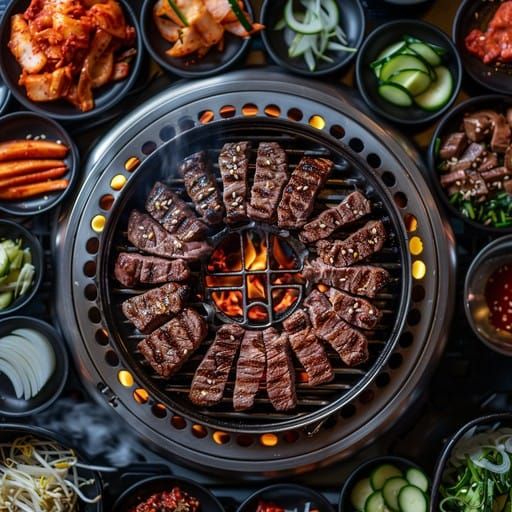
A silence quickly descends at a Korean barbecue table within the first minute of placing the meat on the grill. Someone instinctively takes the tongs, another reaches for the scissors. No one assigns these actions; they happen automatically, much like at previous tables. To outsiders, it appears to be just the start of a meal, but those familiar with the ritual experience it as a brief, rehearsed act—complete with roles, manners, and stakes that go beyond just the food.
Korean BBQ — gogi-gui (고기구이), meaning "grilled meat" — is well known worldwide as a type of cuisine. But its lesser-known role outside Korea is as a social structure: a repeated pattern in Korean culture that goes beyond what a conference room or coffee meetup can achieve—temporarily easing hierarchies, fostering obligation and reciprocity, and nurturing a unique closeness called jeong (정).
What's actually on the table?
Before exploring the history and social aspects, it's essential to clarify what a Korean BBQ spread consists of, since the format only makes sense once you understand how the different elements integrate.
The meat options feature pork belly, or samgyeopsal (삼겹살), which is the most popular in South Korea. It's typically served unmarinated and sliced thickly so the fat melts slowly on the grill. Beef short ribs, called galbi (갈비), are often marinated in soy-pear or soy-Asian-pear sauces and are usually reserved for special occasions or upscale restaurants because beef is more expensive than pork. Bulgogi (불고기), thinly sliced marinated beef, is more familiar to international diners and is usually cooked in a shallow domed pan rather than a flat grill. Other common selections include pork jowl (hangjeongsal), beef brisket (yangji), and various offal cuts (makchang, gopchang), which are popular at specialized eateries.
The banchan. Before the main meat arrives, the table is filled with small, shared side dishes—banchan (반찬)—which many restaurants refill without additional charge. A typical variety includes several types of kimchi, pickled radish, bean sprouts, seasoned spinach, and a simple salad with a vinegared gochujang sauce. These side dishes are more than just decoration; they are an essential part of the meal, intended to be enjoyed throughout rather than quickly finished and discarded.
The wrap and its components. The ssam (쌈) — a leaf wrap made from lettuce or perilla and filled with grilled meat, rice, and condiments — is the core of the meal. Common fillings include raw or grilled garlic, sliced chili, a thin slice of onion, and one of two dipping sauces: ssamjang (쌈장), a thick fermented soybean and chili paste, or gireumjang (기름장), a simple sesame oil and salt mixture mainly used for beef.
The conclusion of a meal typically features a starch dish rather than dessert, such as doenjang-jjigae (된장찌개), a fermented soybean stew, or naengmyeon (냉면), cold buckwheat noodles. Occasionally, these are cooked with the residual meat fat and juices at the bottom of the grill as a final dish called bokkeumbap (볶음밥, fried rice).
None of this is simple for the social function described below. The division of labor at the table — such as who tends the grill, assembles the wraps, or gets served first — exists only because many moving parts must be coordinated at once.
Two histories that are often mistaken for each other
Ask most food blogs about the origins of Korean BBQ, and they'll often trace it to the Goguryeo kingdom (37 BCE–668 CE), when the nomadic Maek people cooked meat on skewers in a dish called maekjeok. While this is correct, the narrative is often extended beyond the available historical evidence.
Maekjeok is an authentic dish with an ancient history documented in the Korea Journal. Over centuries, it evolved into seoryamyeok, a marinated beef dish served in cold water, and later into neobiani, a dish enjoyed by Joseon dynasty royalty. By the 20th century, this lineage culminated in modern bulgogi. Its historical timeline spans approximately two thousand years.
This lineage describes a dish—marinated, skewered, pre-prepared meat—not the typical Korean BBQ image of diners grilling raw meat together at the table with shared equipment. There is debate over when this style first emerged, with a popular claim linking it to the Goryeo dynasty. However, that claim is usually based on a single, uncited secondary source and lacks strong evidence. More credible research and insights from Korean culinary historians suggest that the tabletop grill style mainly developed in the 20th century. It gained popularity during South Korea's postwar industrialization in the 1960s and 70s and reached its modern form by the 1980s and 90s. This distinction matters because it separates the well-supported understanding that grilled meat in Korea is ancient from the idea that the communal, tableside grilling ritual is 2,000 years old, which lacks strong evidence. While the dish itself is ancient, the social ritual centered on a shared grill emerged much later, becoming widespread only after postwar economic growth made meat affordable for average households.
This isn't merely nitpicking; it affects how we interpret the ritual. Korean BBQ is not a timeless museum artifact that has remained unchanged for centuries. Instead, it functions as a modern social technology that blends ancient ingredients and techniques.
The unspoken duties associated with the table
At any Korean BBQ table, a clear division of roles naturally emerges over time without explicit instructions. Typically, the person overseeing the grilling — often the eldest, the host, or the most experienced diner — manages the fire. They monitor the heat, flip the meat, cut it with kitchen scissors, and serve others before themselves.
The arrangement is reciprocal rather than one-sided: diners prepare an ssam and silently pass it to the person at the grill as a gesture of gratitude. Anthropologists who study commensality—the social act of eating together—suggest that these small, repeated acts of care build bonds more than the food itself. Robin Dunbar's 2017 Oxford study, "Breaking Bread: The Functions of Social Eating," analyzed UK survey data and used path analysis to show that shared eating increases closeness, not the other way around. In essence, eating together actively promotes closeness rather than merely reflecting it.
It's important to clarify what Dunbar's study demonstrates and what it does not. The research was not specifically about Korean BBQ; rather, it was a general finding on communal eating based on British survey data. Extending this to the Korean dining tradition is a logical application of the underlying mechanism, but it is not a direct test. It's useful to remember this distinction rather than assuming the connection is more established than it truly is.
This informal etiquette governs the division of labor and is mostly unspoken yet immediately understood. Usually, elders or the most senior person at the table eats first or is served first. Filling others' drinks and having yours filled in return is expected, helping everyone stay attentive to each other during the meal. When pouring for a senior or elder, it’s polite to hold the glass with both hands or steady the wrist with the other hand. At the grill, meat is typically flipped and cut with tongs and scissors, not chopsticks, and the person nearest the grill or the most senior usually decides when the food is ready. Removing food before it's officially done can be seen as impatience.
These customs are minor on their own, but stacked together over a two-hour meal, they do real work: they keep everyone oriented toward each other rather than toward their own plates, which is close to the point of the ritual in the first place.
The same grill for multiple occasions
The roles and etiquette described are common at Korean BBQ, but their specific forms vary depending on who is at the table.
Family gatherings—such as birthdays, graduations, and visits home—are common events that often subtly shift the usual workplace hierarchy: the youngest adults in the family are typically expected to cook and serve, demonstrating visible filial respect toward parents and grandparents rather than submitting to a boss. Korean BBQ is also a popular choice for early-stage dates, partly because the shared, hands-on cooking activity gives the pair something to coordinate beyond conversation, making initial meetings feel less pressured. Among friends, this format is even more relaxed—roles are interchangeable, no one is considered "the elder," and the meal can easily extend into long conversations over drinks or end quickly.
The types of food vary by region and occasion. Jeju Island is famous for heuk-dwaeji, a black-pig breed raised locally and grilled thicker than the usual mainland samgyeopsal. Suwon is renowned for galbi, linked to its historic cattle market. Gwangyang in South Jeolla province is known for a particular style of bulgogi: thinly sliced beef seasoned just before grilling over charcoal on a flat copper or brass plate, contrasting with Seoul's common broth-based, hot-pot bulgogi. Recently, muhan-ribeu (무한리필), or all-you-can-eat Korean BBQ, has gained popularity among younger, budget-conscious diners, especially university students. It offers a more casual, egalitarian experience in which everyone grills their own meat rather than relying on a designated cook.
Among all these settings, one has received more focused study than the others, mainly because the stakes are the highest.
Hoesik: the most extensively researched form of the ritual
If the family dinner table represents the social dance of Korean BBQ, then the workplace dinner — hoesik (회식, meaning "gathering to eat") — turns it into a tool, for better or worse.
Hoesik is a formal organizational practice rather than merely a team-building metaphor. A 2015 peer-reviewed study by Çakar and Kim, published in the Turkish Journal of Business Ethics, highlights hoesik as an essential socialization method within Korean companies. The study notes that earlier Korean survey data indicate that a significant number of employees drink primarily to socialize with colleagues, and that many do so at least weekly.
The mechanics of hoesik are similar to those of the grill, but they operate on a larger scale.
The hierarchy remains clear rather than disappearing. Typically, the most senior person chooses the venue, makes the first toast, and often pays for the event. Juniors are expected to pour drinks for seniors, hold the bottle with both hands (or support the pouring wrist with the other hand) as a sign of respect, and often handle grilling duties.
Hierarchy is temporarily relaxed, allowing junior staff to speak more openly with their superiors in informal settings. Cross-cultural business research shows that these spaces serve as controlled outlets, offering greater openness than is typically permitted in the office—a necessary release within a strict, status-driven system.
The event follows Korean drinking customs and is often organized into numbered "rounds"—such as 1cha at a BBQ, sometimes progressing to 2cha (a second bar) or 3cha (private karaoke). Each round has specific social norms for who stays and how to exit politely.
This process is not without drawbacks. While research shows that hoesik helps build bonds, it also highlights a downside: what appears to be voluntary socializing can sometimes become an obligation. Juniors, in particular, often feel pressured to keep drinking beyond their comfort level. The very ritual that fosters trust can also make it difficult to decline.
The ritual is in the process of being renegotiated.
Nothing is definitive yet. Korean workplace culture is gradually loosening its grip on traditional hoesik customs. Surveys and industry reports indicate that younger professionals are increasingly opting for alcohol-free alternatives such as coffee, board games, or short dinners, while still maintaining important social bonding outside work. Leaving after the first or second round, once a minor social risk, is now increasingly accepted among younger employees with minimal resistance.
It's fascinating that the essential aspects—food, group grilling, small acts of reciprocity, and brief shifts in hierarchy—are still strong even without alcohol, more so than you'd expect if drinking were the main reason. This suggests that the grill itself, rather than the soju, is likely the key to fostering connection.
What makes the grill especially important?
It's worth exploring why this format—sharing raw meat, live fire, and designated cooking roles—has proven more effective for social bonding than other shared meal styles. A key reason is structural: unlike pre-plated dishes, tableside grilling depends on cooperation. Someone needs to manage the fire, determine when the meat is cooked, and serve. This setup not only fosters social interaction but also makes it an essential part of the experience.
It's essential to approach cross-cultural comparisons carefully here. While Japanese yakiniku is sometimes seen as a less communal version of Korean BBQ, this is often an overstatement — yakiniku also features shared, do-it-yourself tableside grilling, and many descriptions highlight its communal nature. Across various sources, the true difference is more subtle: Korean BBQ typically involves pre-marinated meat served family-style in larger shared portions, whereas yakiniku often grills unmarinated or lightly salted meat and pairs it with dipping sauces, served in smaller, more costly individual cuts. This difference reflects variations in flavor and portion sizes, rather than the level of communal grilling.
Ultimately, the main idea is that cooperation is essential. The grill isn't merely a backdrop for social gatherings; it actively fosters and shapes the ritual.
Methodology and Sourcing
Korean food history is deeply rooted in oral traditions and blog posts. Recognized facts may vary across sources—from accepted facts to unverified guesses. To ensure clear sourcing, each claim is categorized into one of three reliability levels
Tier | What it means | How it's stated in this piece |
Tier 1 — Peer-reviewed research or documented primary history | Published in a peer-reviewed journal, or traceable to a specific historical record cited by food-history scholarship | Stated as established fact |
Tier 2 — Reporting, official/heritage sources, or culinary-historian accounts | Covered consistently by culinary historians, city/tourism heritage pages, or reputable food journalism, without a peer-reviewed study behind it | Stated with attribution ("according to," "reporting suggests") rather than as flat fact |
Tier 3 — Repeated but unverified claim | Shows up often on tourism or lifestyle sites, with no traceable source better than "everyone says this" | Named explicitly as unverified, or left out |
Tier 1: Dunbar (2017), "Breaking Bread: The Functions of Social Eating," Adaptive Human Behavior and Physiology— the causal link between shared eating and social bonding. Çakar & Kim (2015), "Korea's Drinking Culture: When an Organizational Socialization Tool Threatens Workplace Well-Being," Turkish Journal of Business Ethics— hoesik as a documented organizational practice. Food-history scholarship on the maekjeok → seoryamyeok → neobiani → bulgogi lineage, published in the Korea Journal.
Tier 2 includes Korean culinary-historian accounts, such as Joo Young-ha's A Korean History on the Dinner Table, as well as food journalism on the development of the built-in tabletop grill in the 20th century. It also cites official city and tourism sources on Suwon galbi's history, linked to the local cattle market, and on Gwangyang bulgogi's charcoal and copper-plate method. Additionally, a cross-cultural business etiquette resource (Cultural Atlas, SBS) discusses hoesik's role in temporarily reducing hierarchy.
Tier 3, designated and set apart rather than presented as fact: the common assertion linking the tableside grilling style to the Goryeo dynasty, which relies on a single, unreferenced secondary source; broad assertions about Confucian ritual symbolism; and specific corporate hoesik policies that lack traceable sources beyond promotional materials or anecdotal accounts.