What Is Mudo? The Korean Concept of the Martial Way
Mudo (무도, 武道) is a Korean term usually translated as "the martial way" or "the way of martial arts." It conveys the idea that the practice of fighting arts is not merely a set of combat techniques but a lifelong path of self-cultivation.
Overview
Mudo (무도, 武道) is a Korean term usually translated as "the martial way" or "the way of martial arts." It conveys the idea that the practice of fighting arts is not merely a set of combat techniques but a lifelong path of self-cultivation — a discipline that shapes character, sharpens the mind, and refines the spirit. In mudo, the training floor becomes a place to confront and conquer not an external enemy but oneself.
The same two Chinese characters are read as budō in Japanese and wǔdào in Chinese, so mudo belongs to a shared East Asian family of ideas about martial practice as a vehicle for moral and spiritual development. Within Korea, however, mudo has its own long history, drawing on Confucian ethics, Buddhist meditation, Daoist philosophy, and the peninsula's indigenous warrior traditions.
Crucially, mudo has never meant empty-hand fighting alone. For most of Korea's history, the warrior was first an archer and a swordsman, and the weapon arts — above all the bow and the blade — are the oldest layers of the tradition. The empty-hand arts the world now associates with Korea, taekwondo and hapkido, are by contrast very young. This article first sets out what mudo means, then traces how the tradition was assembled over time — from the bow, through the sword, to the empty hand — and finally examines how it lives today.
The Meaning of the Two Characters
Mudo is composed of two characters, and understanding each clarifies the whole.
무 (mu, 武) — martial / military. This character is traditionally analyzed as a combination of 止 (ji, "to stop") and 戈(gwa, "halberd" or "spear"). On this classical reading—famously recorded in the ancient Chinese chronicle Zuo Zhuan—the true purpose of martial power is to stop the spear, that is, to end conflict rather than perpetuate it. Martial skill exists to restore peace, not to glorify violence.
도 (do, 道) — way / path. This character is the same as the Chinese dao (as in Daoism) and the Japanese dō (as in judo or kendo). It signifies a path of practice and a principle to live by — an ongoing journey rather than a fixed destination. When do is attached to a discipline, it elevates that discipline from a technical pursuit to a way of life.
Together, mu and do express a single idea: martial practice undertaken as a path of personal transformation, ultimately oriented toward harmony rather than destruction.
Three Words for Martial Arts: Musul, Muye, and Mudo
Korean preserves a meaningful distinction among three related terms that are often blurred together in English as "martial arts." The progression among them reflects a deepening of practice.
무술 (musul, 武術) — martial technique. This is the practical, combative layer: strikes, throws, joint locks, and weapon skills that enable a person to fight effectively. Musul focuses on what works.
무예 (muye, 武藝) — martial art. This adds an artistic and craftsmanlike dimension — refinement, precision, beauty of movement, and the cultivation of skill as a form of expression. The classical eighteenth-century Korean military manual Muyedobotongji takes its name from this term.
무도 (mudo, 武道) — martial way. This is the philosophical and ethical summit. Here, techniques and artistry are no longer ends in themselves but means toward self-mastery, moral growth, and inner peace.
Practitioners often describe an ideal progression from musul to muye to mudo: one first learns to fight, then learns to fight with refinement, and finally comes to understand why — and discovers that the deepest aim of the training was never combat at all.
Philosophical Foundations
Mudo did not arise in isolation. It absorbed the major currents of East Asian thought that shaped Korean history.
Confucianism emphasizes self-cultivation, social harmony, and proper conduct. Values such as etiquette and propriety (예, ye), loyalty, filial piety, sincerity, and respect for teachers and elders are deeply woven into martial training. The Confucian ideal of becoming a junzi — a person of cultivated virtue — closely aligns with the mudo aspiration to build character through discipline.
Buddhism contributes meditation, mindfulness, and the pursuit of unity between mind and body. The aim of clearing the mind, acting without anxious attachment to winning or losing, and cultivating equanimity under pressure reflect Buddhist influence. Many Korean martial traditions have historically been connected to Buddhist monasteries and monks.
Daoism contributes the central concept of do — living in accordance with natural principle, seeking balance and harmony, and the ideal of effortless, unforced action. The Daoist sensibility appears in an emphasis on yielding, redirecting force, and finding strength in softness and flow rather than in rigid resistance.
Indigenous Korean warrior traditions — from the martial culture of Goguryeo, through the Hwarang of Silla, to the codified arts of Joseon — gave these imported philosophies a distinctly Korean form by fusing martial skill with ethics, scholarship, and the arts.
A Braided Lineage: From the Bow to the Empty Hand
It is tempting to imagine mudo as a single, unbroken tradition handed down for two thousand years. The more honest and more interesting picture is that mudo is a braid assembled over time — distinct strands, each contributing something the others lack, woven together under a single name only in the twentieth century. Read in order, the tradition runs from the bow of ancient Goguryeo, through the sword and warrior-ethics of Silla, to the great documentary synthesis of Joseon, and finally to the modern empty-hand arts. Tellingly, the weapons came first; the famous unarmed arts came last.
Goguryeo and the Bow — The Oldest Stratum
If any single weapon is the root of the Korean martial tradition, it is the bow. Koreans were renowned as master archers across East Asia from deep antiquity, and the earliest rich record comes from Goguryeo (c. 37 BCE–668 CE), the northernmost and most militarized of the Three Kingdoms. Hardened by centuries of war with Chinese dynasties and steppe neighbors, Goguryeo left tomb murals depicting hunters loosing arrows from galloping horses — mounted archery at full speed. Its legendary founder, Jumong, took his very name from his fame as a peerless archer. The Korean composite horn bow (각궁, gakgung) — a small, immensely powerful reflex bow built from horn, sinew, bamboo, and wood — would become one of the most sophisticated traditional bows ever made.
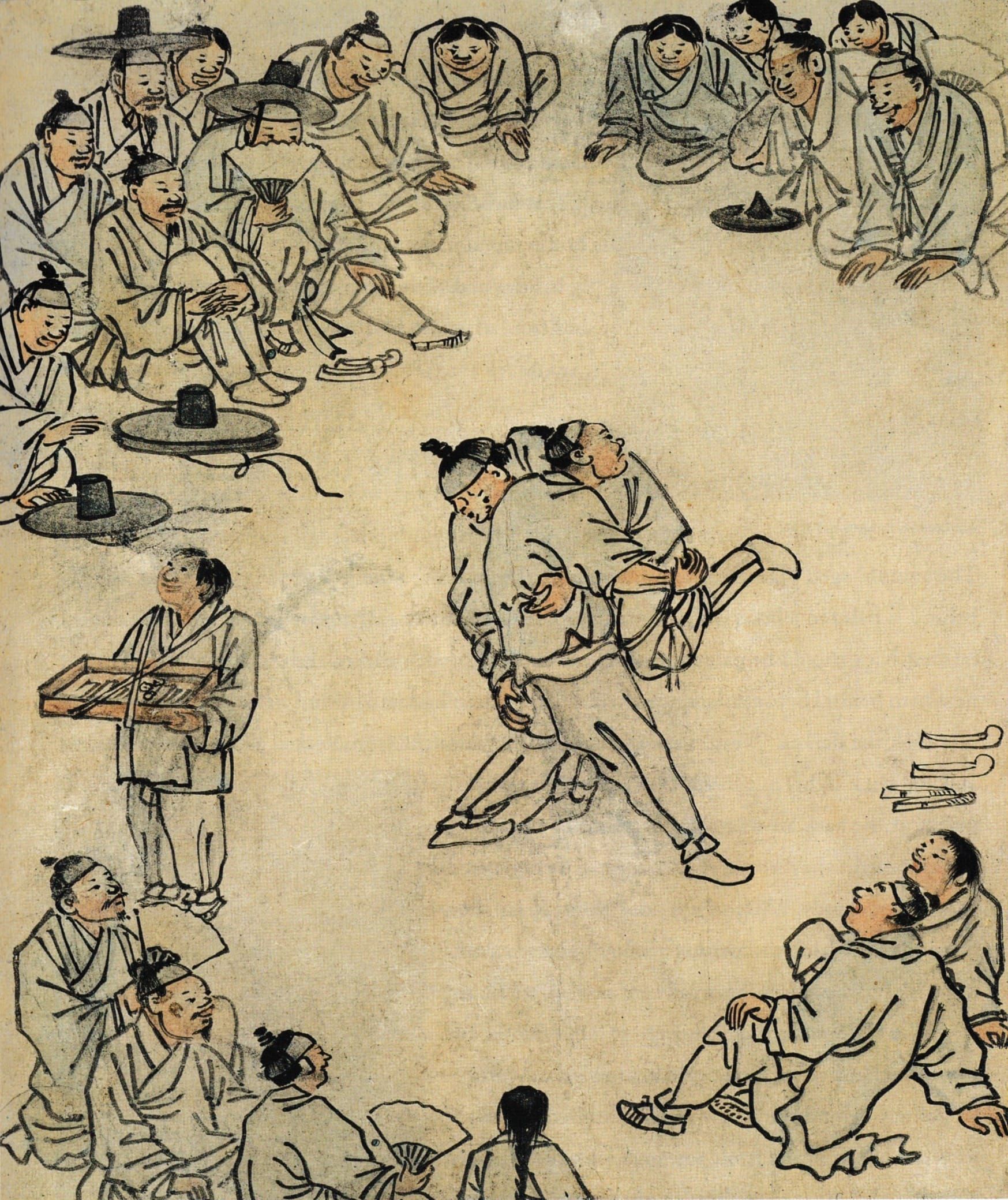
The same murals preserve the earliest evidence of other martial practices as well: the Tomb of the Wrestlers (Gakjeochong) depicts two men locked in a grappling match, often interpreted as an ancestor of Korean ssireum and of the peninsula's early grappling and striking arts. (A popular claim holds that Goguryeo also maintained a corps of trained young men — the Joui Seonin or Seonbae — as a northern counterpart to Silla's later Hwarang; however, this parallel derives largely from the early-twentieth-century nationalist historian Sin Chaeho rather than from secure contemporary records, and mainstream historians do not treat it as a documented institution.[1])
Goguryeo's gift to mudo is the most elemental: vigor, prowess, and above all the bow — the warrior body and the archery-and-horsemanship culture that constitute the physical raw material of any "way." This is mu before it has fully become do.
Silla: The Hwarang and the Sword
If Goguryeo supplied the body, the Hwarang (화랑, "flowering knights" or "flower youth") of the Silla kingdom (roughly the sixth to ninth centuries) supplied the soul. The Hwarang were bands of young aristocratic men who trained together not only in martial arts but also in music, poetry, scholarship, and ethics. They were expected to become well-rounded leaders, balancing the martial and the cultured — the very integration that mudo idealizes. Their decisive move, and the reason they sit at the conceptual center of mudo, was to treat martial training and moral cultivation as a single project: a Hwarang was meant to become a virtuous, cultured leader through the discipline of arms, not merely an effective fighter.
Their guiding code, the Sesok Ogye (세속오계, "Five Secular Injunctions"), is traditionally attributed to the Buddhist monk Won Gwang.
- 사군이충 (sagun-i-chung) — Serve your sovereign with loyalty.
- 사친이효 (sachin-i-hyo) — Serve your parents with filial devotion.
- 교우이신 (gyou-i-sin) — Treat your friends with trust and faithfulness.
- 임전무퇴 (imjeon-mutoe) — Never retreat in battle.
- 살생유택 (salsaeng-yutaek) — Practice discernment in taking life.
The fifth injunction is especially revealing of the mudo spirit: even a warrior code restrains killing and demands moral judgment about when force is justified. The ideal is not a bloodthirsty fighter but a disciplined person who wields power responsibly. One honest caveat belongs here: our picture of the Hwarang is reconstructed from limited and often late sources, and the most detailed-seeming of them, the Hwarang Segi manuscripts that surfaced in 1989 and 1995, are regarded by most scholars as a forgery — probably a colonial-era historical fiction — rather than an authentic Silla record.[2] The popular image of the Hwarang as a warrior academy is therefore partly a modern romanticization of what was also a religious and aesthetic institution. However, the core ideal — martial training as the forging of character — is real, and it is the root of mudo as a philosophy.
Silla is also where the sword acquires its Korean lineage. Later tradition traces the bonguk geom (본국검, the "native sword") and its method to Silla and its warrior culture, as dramatized in the legend of the Silla youth Hwangchang, who is said to have killed a rival king while performing a sword dance. The story is stirring, but it is worth noting that this Silla attribution is largely a later, patriotic framing rather than a firmly established historical account.[4] Even so, it marks the moment the blade joins the bow as a recognized bearer of the Korean martial way.
Joseon: The Manuals and the Confucian Frame
The Joseon dynasty (1392–1897) is where the story becomes both richer and more paradoxical. Joseon was a thoroughly Neo-Confucian state that revered the scholar and looked down on the soldier — an attitude captured in the phrase sungmun cheonmu (숭문천무), roughly "exalt the pen, scorn the sword." In that sense, the dynasty demoted the warrior. Yet the same Joseon, driven by the catastrophe of the Japanese invasions of 1592–1598 and the later Manchu wars, produced the most extensive documentation of Korean martial arts ever made: a line of royal manuals running from the Muyejebo (무예제보, 1598, with an expanded sequel in 1610) to the Muyesinbo (무예신보, 1759), which expanded the original six disciplines to eighteen (the sippalgi), to the magisterial Muyedobotongji (무예도보통지, variously dated 1790–1795), which records twenty-four fighting disciplines spanning sword, spear, staff, empty hand, and mounted combat.[3] It is the single richest source modern Korean arts draw upon; the classical sword forms such as the bonguk geom and the empty-hand kwonbeop are preserved in it.
Joseon also codified the form of Korean traditional archery. The bow was aligned with the Confucian ideal of the cultivated gentleman, for whom archery was one of the Six Arts and a discipline of self-examination: Confucian thought repeatedly held up the archer as a model of inward reflection, since when the shot misses, the true archer blames neither the wind nor the target but corrects his own posture and mind. This is one of the purest statements of the central mudo conviction — that the real opponent is always oneself. The etiquette, the long shooting distance, and the practice at fixed pavilions that still define Korean traditional archery today are largely a Joseon inheritance.
Joseon's contribution to mudo is therefore threefold: the texts that provide modern practice with its content and legitimacy, the Confucian framework of etiquette and self-cultivation that still shapes the training hall, and — by subordinating the warrior — part of the very reason so much had to be consciously revived in the twentieth century.
The Twentieth Century: The Modern Weave and the Kwan Era
The final twist came after Korea's liberation from Japanese colonial rule in 1945. Korean masters consciously wove these strands into the tradition we now call mudo: they claimed the Hwarang spirit as their ancestral ideal, drew on the Muyedobotongji for technique and legitimacy, and asserted an indigenous Korean martial identity distinct from Japanese budo. The result is not a single ancient bloodline but a modern weaving of genuinely ancient threads — Goguryeo's vigor, the Hwarang's ideal, and Joseon's documentation — tied together into one "way."
But the twentieth century also added something genuinely new — and partly foreign. The empty-hand arts now most associated with Korea were shaped during the Japanese occupation (1910–1945) by Japanese systems. Taekwondo's early development drew heavily on karate brought back by Korean masters who had trained in Japan, while hapkido traces its roots to Japanese Daitō-ryū aiki-jujutsu through its founder, Choi Yong-sool — though the extent of his training is disputed. Choi's claim to have been Takeda Sōkaku's adopted son and a thirty-year disciple is unsupported by Takeda's famously meticulous enrollment ledgers, yet photographs placing Choi among Daitō-ryū students, a recollection of a young Korean attending one of Takeda's seminars, and a later enrollment-register entry all place him within Takeda's circle. The argument is over how formally he trained, not whether he was exposed to the art at all.[5]
If this modern weave has a loom, it is the kwans — the schools (관, 館) that opened in the years immediately after liberation and transformed the inheritance into the arts practiced today. The kwans are the concrete mechanism by which imported technique, recovered tradition, and nationalist ambition were braided into a single modern art. Five "original" kwans were founded in the brief window between liberation in 1945 and the Korean War: the Chung Do Kwan ("Blue Wave School," Lee Won Kuk, 1944), the first and largest; the Song Moo Kwan (Ro Byung Jick, 1944); the Yun Moo Kwan, which became the Jidokwan ("School of Wisdom," Chun Sang Sup, 1946) after its founder vanished during the war; the Moo Duk Kwan ("School of Martial Virtue," Hwang Kee, 1945); and the YMCA Kwon Bup Bu, later the Chang Moo Kwan (Yoon Byung In). Four more "annex" kwans branched off after the war — among them the military Oh Do Kwan (Choi Hong Hi, 1955) — bringing the canonical total to the Nine Kwans.[6]
The unification was slow and state-driven. A 1955 committee proposed the name taekwondo, but most kwans resisted, preferring Kong Soo Do ("empty-hand way"). The government was the decisive force: in 1961, President Park Chung-hee directed the kwans to merge under the Korea Taekwondo Association; a Unification Declaration followed in 1965; and the kwan system was not formally dissolved until 1978, when the schools were folded into the Kukkiwon system.[7] Two lineages stood apart: Choi Hong Hi went on to found the International Taekwon-Do Federation and his own line, while Hwang Kee withdrew the Moo Duk Kwan in 1958 and preserved Tang Soo Do and Soo Bahk Do as separate arts. Tellingly, it was Hwang Kee's Moo Duk Kwan that carried the Joseon strand straight into the modern era: his encounter with the Muyedobotongji in 1957 led him to rebuild his art around the native Subak and rename it Soo Bahk Do.
The Kwan era is the modern weave in miniature. Its founders learned their core art abroad during the occupation — mostly Japanese karate, with Chinese chuan-fa in the Chang Moo Kwan line — so the technical raw material of early taekwondo was substantially foreign. Only afterward, under a nationalist government, were the schools merged, given an indigenous name chosen to echo taekkyon, and retrofitted with a Hwarang and subak pedigree. There has been a strong and ongoing effort in Korea to recover and emphasize indigenous roots and to define mudo as a distinctly Korean way — and even traditional archery, for that matter, was formally standardized into its present sporting form only around 1899–1920, partly under Japanese occupation. Hence, its modern shape is more recent than its ancient pedigree suggests. These tensions are not a flaw in the tradition so much as the texture of a living one.
The Living Arts: Mudo Today
Mudo belongs to a broad East Asian family of disciplines that share the do/dō/dao suffix — Korean taekwondo (태권도), hapkido (합기도), gumdo (검도), gungdo (궁도), and tang soo do (당수도); Japanese judo, kendo, kyudo, aikido, and karate-do; and beyond the martial sphere, arts such as the tea ceremony (chadō) and calligraphy (shodō). In each case, the do signals that the activity is approached as a path of cultivation. The empty-hand arts have been discussed above; the two great weapon ways merit a closer look as living disciplines because they embody the philosophy of the way as fully as any striking art — and, in the case of the bow, arguably more deeply.
The Sword Today: Gumdo
The word combines 검 (geom, 劍, sword) and 도 (do, 道, way) — the same two characters read as kendō in Japanese. (In strict Revised Romanization, it is geomdo; "gumdo" is the spelling used here.) In Korea today, gumdo encompasses two related but distinct streams. The first is gumdo as the Korean form of kendo: a modern sparring discipline practiced with a bamboo sword (죽도, jukdo) and protective armor, organized around competition and governed by Korea's national gumdo association. It came to Korea largely through the Japanese colonial period and shares its rules and equipment with Japanese kendo, though Korean practitioners have built their own competitive identity within it. The second is Haedong Gumdo (해동검도), a modern Korean sword art founded in the late twentieth century that emphasizes solo and partner forms (검법, geom-beop), cutting practice, and a strongly Korean identity. Its proponents trace its lineage to ancient Korean swordsmanship, though many historians regard those specific claims of unbroken antiquity as doubtful. Both streams draw self-consciously on the classical sword methods recorded in the Joseon Muyedobotongji.
Philosophically, the sword teaches what no padded sparring can convey so vividly: the cost of a divided mind. A single decisive cut demands total commitment, perfect timing, and a mind unclouded by fear or hesitation — the state of mushin (무심, "no-mind"), in which thought no longer intrudes between intention and action. Because the sword once carried the literal weight of life and death, it became one of the purest schools of presence and of the unity of breath, mind, and blade. To master the sword is, in the language of mudo, to cut away one's own ego.
The Bow Today: Gungdo
The word joins 궁 (gung, 弓, bow) with 도 (do, 道, way) — the same characters read kyūdō in Japanese. In Korea, it is also called gukgung (국궁, the "national bow"), distinguishing native traditional archery from Western, Olympic-style archery (양궁, yanggung). The bow's ancient heritage dates back to Goguryeo; what is striking is how little the living art has compromised. Traditional archery is still practiced at dedicated ranges and historic pavilions (정, jeong), and it preserves a remarkably demanding standard: the target stands at 145 meters, far beyond the distances of most other traditions, and is still shot with the composite gakgung. A shot at that range cannot be brute-forced; it requires steady breathing, precise posture, and a quiet, undistracted mind. The guiding maxim, 정심정기 (jeongsim jeonggi) — "a correct mind and a correct posture" — states the whole philosophy in four characters: outer form and inner spirit must be aligned before the arrow is ever released. It is no coincidence that a nation with this heritage of the bow as mental discipline has become a dominant force in modern Olympic archery; the spirit of gungdo runs beneath the medals.
Mudo in Practice
The philosophy of mudo is expressed concretely through the everyday rituals and structures of a Korean martial arts school.
The dojang (도장, 道場) is the training hall — literally the "place of the way." The name itself signals that what happens there is more than physical exercise; it is the cultivation of a path. Students bow upon entering and leaving, acknowledging the space as one of focus and respect.
The dobok (도복) is the training uniform — literally "clothes of the way." Wearing it signals the transition to the disciplined mindset of practice.
Etiquette and bowing structure every interaction — bowing to the instructor, to training partners, and to the space. This constant practice of respect is not mere formality; it cultivates humility and reminds practitioners that skill must be paired with character.
The belt-and-grade rank system (the gup levels leading to dan or black-belt levels) frames advancement as a long, patient journey. Notably, reaching the first black belt is traditionally understood not as mastery but as the true beginning of serious study.
Tenets state the values explicitly. In taekwondo, for instance, the commonly taught tenets are courtesy (예의), integrity (염치), perseverance (인내), self-control (극기), and indomitable spirit (백절불굴). These are recited and internalized as the ethical heart of the practice.
The Inner Meaning
Beneath the history and rituals, mudo rests on a few core convictions that give the practice its depth.
The ultimate opponent is oneself. External victories matter far less than the internal work of overcoming fear, ego, laziness, and anger. As a common saying across many martial traditions puts it, the hardest person to defeat is oneself.
Mind, body, and spirit are meant to act as one. Physical training is both mental and moral training; the goal is an integrated person, not merely a capable fighter.
There is a productive paradox at the heart of mudo: one trains rigorously for combat precisely to transcend the need for it. The truly accomplished practitioner, having nothing left to prove, is least likely to seek a fight. This circles back to the old reading of mu as "stopping the spear."
Mastery is a way, not a destination. Because it is a path, it is never finished. The practitioner remains, in a meaningful sense, always a student.
Modern Relevance
Today, Mudo continues to shape how millions of people worldwide encounter Korean martial arts. Even where taekwondo is practiced as an Olympic sport with an emphasis on competition, instructors often return to mudo language — discipline, respect, perseverance, character — to articulate what distinguishes a martial art from mere athletics. For many practitioners, the appeal lies precisely in this fusion of physical challenge and ethical and personal growth.
In a broader sense, mudo offers a model that goes beyond fighting altogether: the idea that any demanding discipline, approached with patience, humility, and seriousness, can become a path to self-transformation. That is the enduring promise carried in the small word do.
Mudo, in the end, is less a technique than an orientation: the choice to treat the martial arts not as a means to dominate others but as a means to become a better, more disciplined, and more peaceful human being.
A Note on Sources and Historicity
Readers should know that the history of Korean martial arts is unusually contested, and for a consistent reason. Modern Korean martial identity was largely forged in the twentieth century under two pressures: a Japanese colonial historiography that portrayed Korea as culturally dependent, and the uncomfortable fact that several modern Korean arts were directly shaped by Japanese systems during the occupation. The nationalist response — beginning with figures such as Sin Chaeho — was to reconstruct a continuous, ancient, indigenous martial lineage and to minimize Japanese influence, while academic historians, working from sources that are often thin, late, or, in one notable case, forged, remain far more cautious. Most of the popular controversies in this field trace back to that single tension between national narrative and source-critical history. This article seeks to honor the genuine heritage while clearly marking where the evidence is firm and where it is traditional, romanticized, or disputed.
Notes
[1]: The claim that Goguryeo's Joui Seonin/Seonbae served as a northern counterpart to the Hwarang is largely based on the early-twentieth-century nationalist historian Sin Chaeho and is not regarded as a documented institution in mainstream scholarship. See discussions of Korean nationalist historiography and of Sin Chaeho's writings on the Sam'rang/Jo'ui lineage.
[2]: The Hwarang Segi manuscripts, published in 1989 and 1995 and attributed to Bak Chang-hwa (1889–1962), are regarded by most Korean and Western scholars as a forgery — probably an unfinished colonial-period historical fiction — though a minority defend their authenticity. See Richard D. McBride II, The Hwarang Segi Manuscripts: From In-progress Fiction to Pseudohistory (Brill), and related articles in Korea Journal and Project MUSE.
[3]: The Muyejebo (1598, with an expanded sequel in 1610) was written after the Imjin War; the Muyesinbo (1759), associated with Crown Prince Sado, added twelve disciplines to the original six, for a total of eighteen (the sippalgi); and the Muyedobotongji, compiled under King Jeongjo by Yi Deok-mu, Park Je-ga, and Baek Dong-su, reached twenty-four disciplines. Its publication date is variously given as 1790, 1791, or 1795.
[4]: The Muyedobotongji emphasizes the antiquity of the bonguk geom ("national sword") by invoking the legend of the Silla youth Hwangchang. However, the form as recorded uses an eighteenth-century single-edged sword rather than the double-edged swords of the Silla period, and a 1673 account attributes the techniques to the Chinese military treatise Wubei Zhi. The Silla attribution is therefore best read as the manual's own patriotic framing.
[5]: Hapkido's founder, Choi Yong-sool (1904–1986), claimed to have been adopted by the Daitō-ryū master Takeda Sōkaku and to have trained under him for roughly thirty years. These claims are unsupported by the meticulous enrollment and fee ledgers kept by Takeda and his son Tokimune, leading some researchers to suggest that Choi was a household servant or informal seminar attendee rather than a formally enrolled disciple, and others to argue that he absorbed much of the art from Takeda's student Yoshida Kotaro. His connection to the Daitō-ryū world is not invented, however: Kisshōmaru Ueshiba (son of aikido's founder) recalled to researcher Stanley Pranin that a young Korean had attended one of Takeda's seminars in Asahikawa, Hokkaidō; Daitō-ryū headmaster Kondō Katsuyuki has cited an enrollment register (eimeiroku) entry indicating that Choi did study with Takeda briefly; and photographs place Choi among Daitō-ryū groups during the Asahi Newspaper period. The dispute is therefore about the formality and extent of his training, not whether he was exposed to the art. Separately, taekwondo's early forms drew substantially on Japanese and Okinawan karate introduced by Korean masters trained in Japan, with indigenous elements emphasized later; the role of figures such as Ji Han-jae in shaping modern hapkido is likewise debated.
[6]: The five original kwans (founded 1944–1946) are conventionally listed as the Chung Do Kwan (Lee Won Kuk, 1944), Song Moo Kwan (Ro Byung Jick, 1944), Yun Moo Kwan / Jidokwan (Chun Sang Sup, 1946), Moo Duk Kwan (Hwang Kee, 1945), and the YMCA Kwon Bup Bu / Chang Moo Kwan (Yoon Byung In, 1946). Four post-war "annex" kwans — Oh Do Kwan (Choi Hong Hi, 1955), Jung Do Kwan (Lee Yong Woo), Han Moo Kwan (Lee Kyo Yoon, 1954), and Kang Duk Won (Park Chul Hee and Hong Jong Pyo, 1956) — complete the "Nine Kwans." Founding dates vary by a year or two across sources, and popular lists range from five to nine, itself a marker of how recent and contested this history is.
[7]: The name taekwondo was first proposed at a naming committee on April 11, 1955. Under President Park Chung-hee, the kwans were directed to unify within the Korea Taekwondo Association in 1961, with a Unification Declaration Ceremony in 1965. The Kwan system was formally closed by a signed proclamation on August 7, 1978, consolidating the schools under the Kukkiwon (established 1972) and the World Taekwondo Federation (established 1973). Choi Hong Hi separately founded the International Taekwondo Federation in 1966; Hwang Kee withdrew the Moo Duk Kwan from the unification in 1958.